
Mention the 1954 Topps baseball set and there are many cards that come to mind. Maybe it’s the trio of Hall of Fame rookie cards of Hank Aaron, Ernie Banks, and Al Kaline. Or maybe it’s the cards of veterans, such as Ted Williams, Willie Mays, and Jackie Robinson. But one that isn’t likely to come up is the card of Johnny Lipon.
What’s so special about Lipon’s card? To the observant, Lipon’s card sticks out like a sore thumb.
About Johnny Lipon
Lipon wasn’t a star player by any means. But he did play in parts of nine major league seasons, proving he was a solid player.
Lipon began his career as a 19-year-old playing for Detroit in 1942 after brief stints in the minors. Despite being young, he proved he belonged almost immediately. In 1941 at the age of 18, he clubbed 35 home runs and hit .359 in Muskegon. By 1942, he was in the Texas League and hit .301 with Beaumont before the Tigers brought him up later in the year.
His brief time in Detroit would be interrupted by service time in World War II. Like many ballplayers, Lipon missed significant time on the diamond. He wouldn’t be seen again until the 1946 season after the war ended. While Lipon struggled in his initial stint with Detroit, he looked back to his minor league form in limited action in 1946, batting .300 in 14 games played. Over the next several seasons, he was an elite hitter, batting .295 in the minor leagues in 1947 and .290 in Detroit in 1948. But while he’d also hit .293 in 1950, Lipon’s hitting dropped off soon after that, as evidenced by his modest career .259 batting average. By 1955 he was out of the majors for good and his career ended with several minor league seasons for a variety of clubs.
Johnny Lipon’s 1954 Topps Card
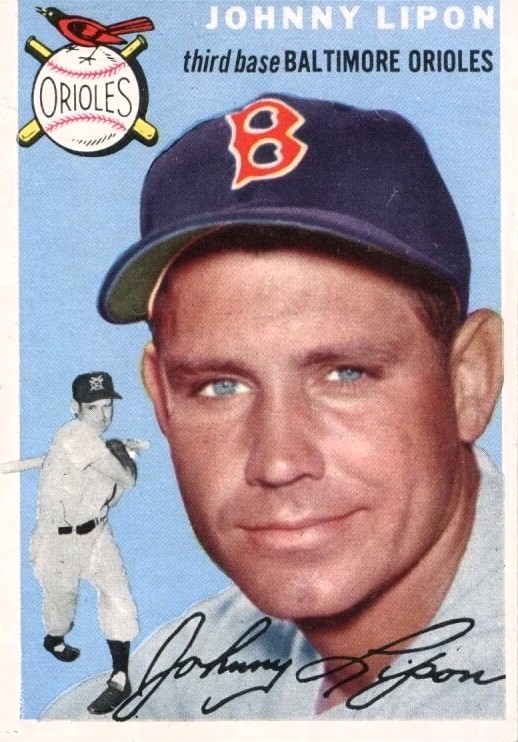
On the surface, Lipon’s 1954 Topps card doesn’t seem too noteworthy. It’s a common card in a pretty basic set and it isn’t too hard to find for just a few dollars. But a closer look reveals it’s one of the more confusing baseball cards you’re likely to see.
A collector posed a trivia question to collectors recently in Old Baseball Cards (OBC), a vintage baseball card group. The question? Which vintage Topps card identifies a player for at least three different current teams?
While I love vintage cards, I’m pretty bad at actual baseball trivia and I couldn’t even fathom a guess. But the answer was quickly revealed as Lipon’s 1954 Topps card. If you look at Lipon’s card as I did, the first thing that jumps out might be the perfect light blue background, which dominates the card and matches Lipon’s own blue eyes. But a deeper look offers some confusing aspects.
Lipon played in Boston in 1953 and that’s the hat he is wearing in his large portrait photograph. But the team’s logo on the front of his card and the team name referenced is as the Baltimore Orioles. And worse still, the back of his card states that he plays for the Chicago White Sox. A fourth point of confusion is in the small image of Lipon batting on the front, which pictures him wearing an obscure hat. Add them all up and there are references to three different clubs — four, if you count the different hat he is wearing in the batting picture.
So what gives?
Explaining the Multiple Teams
Well, turns out there are some explanations here.
Lipon played with Boston in 1953, so that explains the Red Sox hat he is wearing in his large portrait photo. Lipon was then sold to the St. Louis Browns late that year. And even though he did play a handful of games for his new team, Topps likely could not secure a photograph of him in a Browns hat.
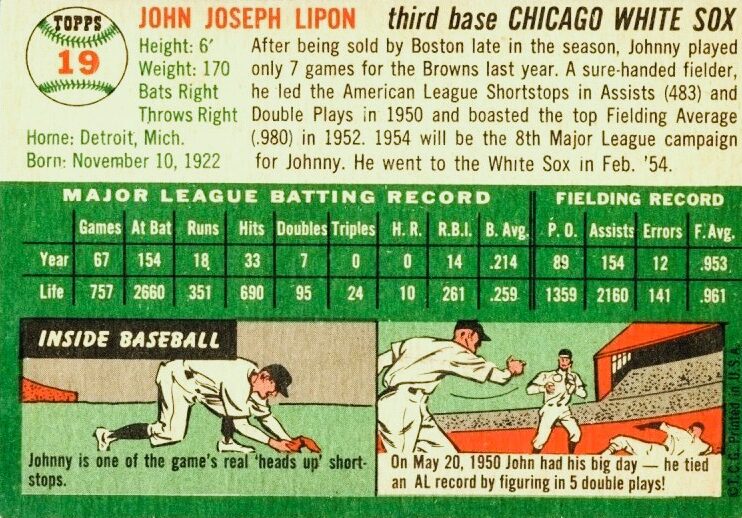
What about the Orioles reference? Well, the Browns moved to Baltimore for the 1954 season and were renamed the Orioles. And because this was a 1954 set, Topps actually got that part right if they were going by the team Lipon was last seen with. But that doesn’t explain the reference to the White Sox on the back.
Turns out, Lipon did indeed get traded to the White Sox early in 1954. But he was soon traded to the Reds and spent most of the season in the minor leagues.
The fourth team that is indirectly mentioned is a bit of an unknown. Lipon’s batting image depicts him wearing a hat that is a bit unidentifiable. Whether it was intended to be a Browns hat, a new Orioles hat, or something else, isn’t all that clear.
So we’ve got the front of Lipon’s card, at a minimum, picturing him as a member of the Red Sox and identified as an Oriole, with the back touting him as a new player for the White Sox.
Lipon did have real ties to those teams. However, the real problem is that Topps wanted to associate him with all of those teams teams at the same time. If Topps had the most recent information of his trade to the White Sox, ideally, they would have changed the information on the front to reflect that. It makes little sense to only mention that on the back while leaving all of the old information on the front. It is possible, of course, that the fronts of all of the cards were already set for printing. It’s possible that they were beyond change by that point.
A Bit More
If you want a bit more, consider two other quick tidbits about Lipon’s error-filled card.
Lipon’s 1954 season saw him play only a single game for Cincinnati. Yet, that is the one team not referenced as it was printed before he apparently joined the club. Topps cites him playing for three teams while omitting the one that was actually the club he played for that season.
Another interesting part of the card is regarding Lipon’s position. While he is appropriately named as a shortstop in his bio, the position for Lipon mentioned on the card’s front and back is as a third baseman. Lipon did play some at third in 1953, but only six of his 67 games were played at that position. He was almost exclusively a shortstop. Why his primary position was cited as third baseman on the card is unclear.
Finally, I do not believe the card was ever corrected. Thus, all copies would have the same teams referenced.
Rarity and Price
As a 1954 Topps common, the card is not terribly hard to find. The card is plentiful on eBay and, as previously mentioned, is not expensive. It can be found in decent condition for $10 or less. If you like quirky vintage cards, the price is right on this one.
