
Once again, the big story of the year in hockey cards has been the unopened case of 1979-80 O-Pee-Chee cards that went to auction last year, and then went back to auction when the original buyer backed out of the sale.
The case has fueled discussions among collectors, on hobby YouTube shows and podcasts, and even among sports fans having a pint and watching Hockey Night in Canada at Canadian sports bar and restaurant chain Boston Pizza.
It is certainly a story that has transcended the hobby and become a mainstream hockey story. People are fascinated with the scarcity of the card in gem mint condition, and there are countless collectors who are north of 50 who had one of those cards at some point in their lives. Many of those collectors either lost their cards, or fell victim to the dreaded “my mom threw them out” scenario.
While the Wayne Gretzky rookie card ranks with the 1952 Topps Mickey Mantle RC and the 1986-87 Fleer Michael Jordan RC, the rest of the 1979-80 O-Pee-Chee hockey card set is rarely talked about.
So what about the set? Why are there only two PSA 10s of Wayne Gretzky’s O-Pee-Chee rookie card in existence? What was significant about that set aside from Gretzky? Who are the other Hall of Famers and rookies with cards in that set?
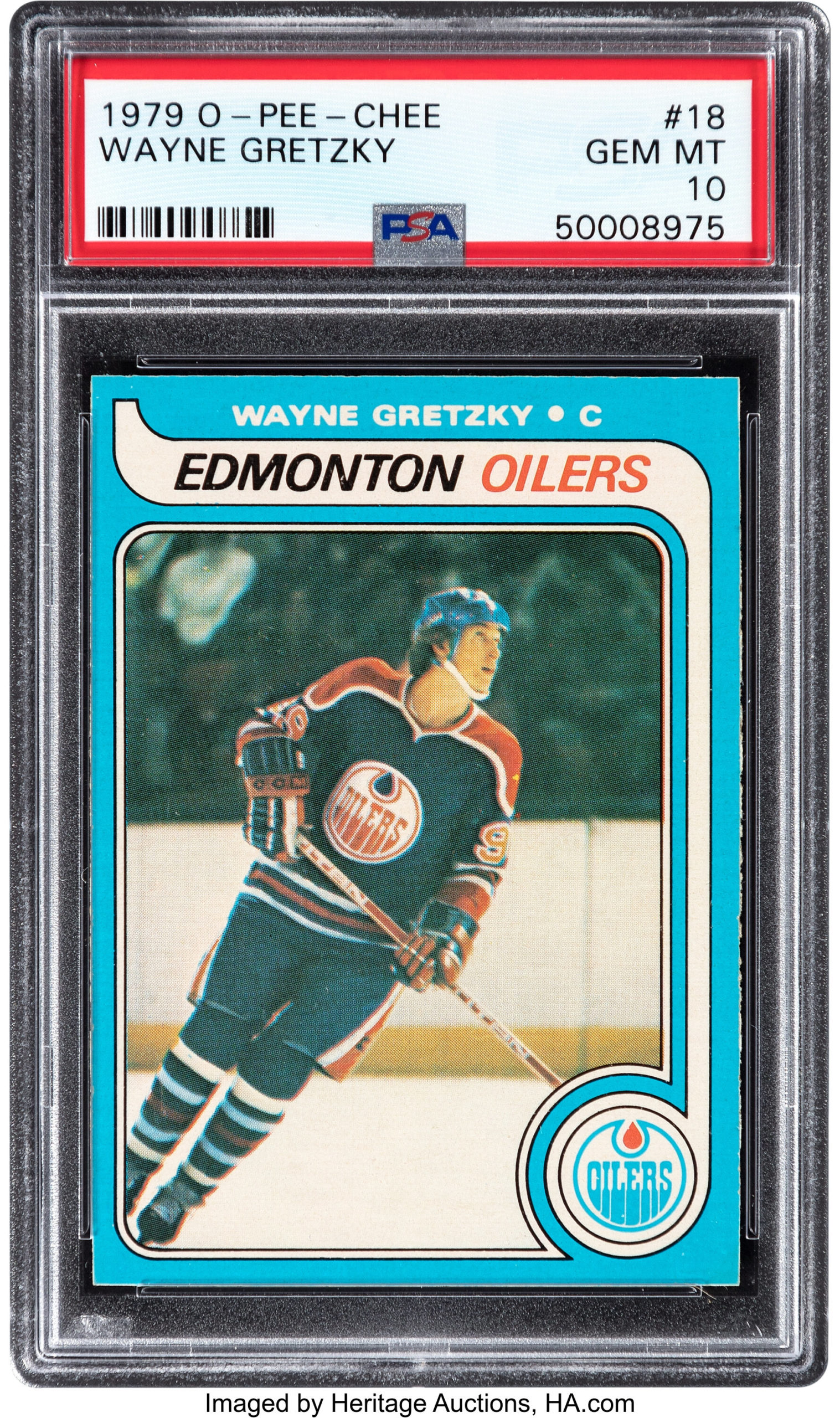
The first thing you need to know about that set is the production and how condition-sensitive that set is.
The first factor in this set is the blue border in the design. Now, 45 years ago and deep into the era of grading, the design makes the grading of that card tough. Any color that bleeds off the card makes getting a high-grade card much more difficult. Even the slightest ink chipping will be noticeable to a grader in that set.
Making things exponentially problematic is that the O-Pee-Chee sheets came off the sets and were wire cut, not blade cut. Wire cutting meant that the edges and corners were not nearly as crisp and clean as today’s card stock and production processes. For that matter, production and quality changed instantly when Upper Deck began producing trading cards about 10 years after the Gretzky card was issued. Upper Deck raised the printing and production bar for everyone.
During those years, the Gretzky O-Pee-Chee rookie card routinely booked in price guides for around $500 in mint condition. Remember that grading was not a thing yet. Today, even a PSA 1 Gretzky RC would sell for about that much.
Grading was very important for the revolution of the Gretzky rookie card.
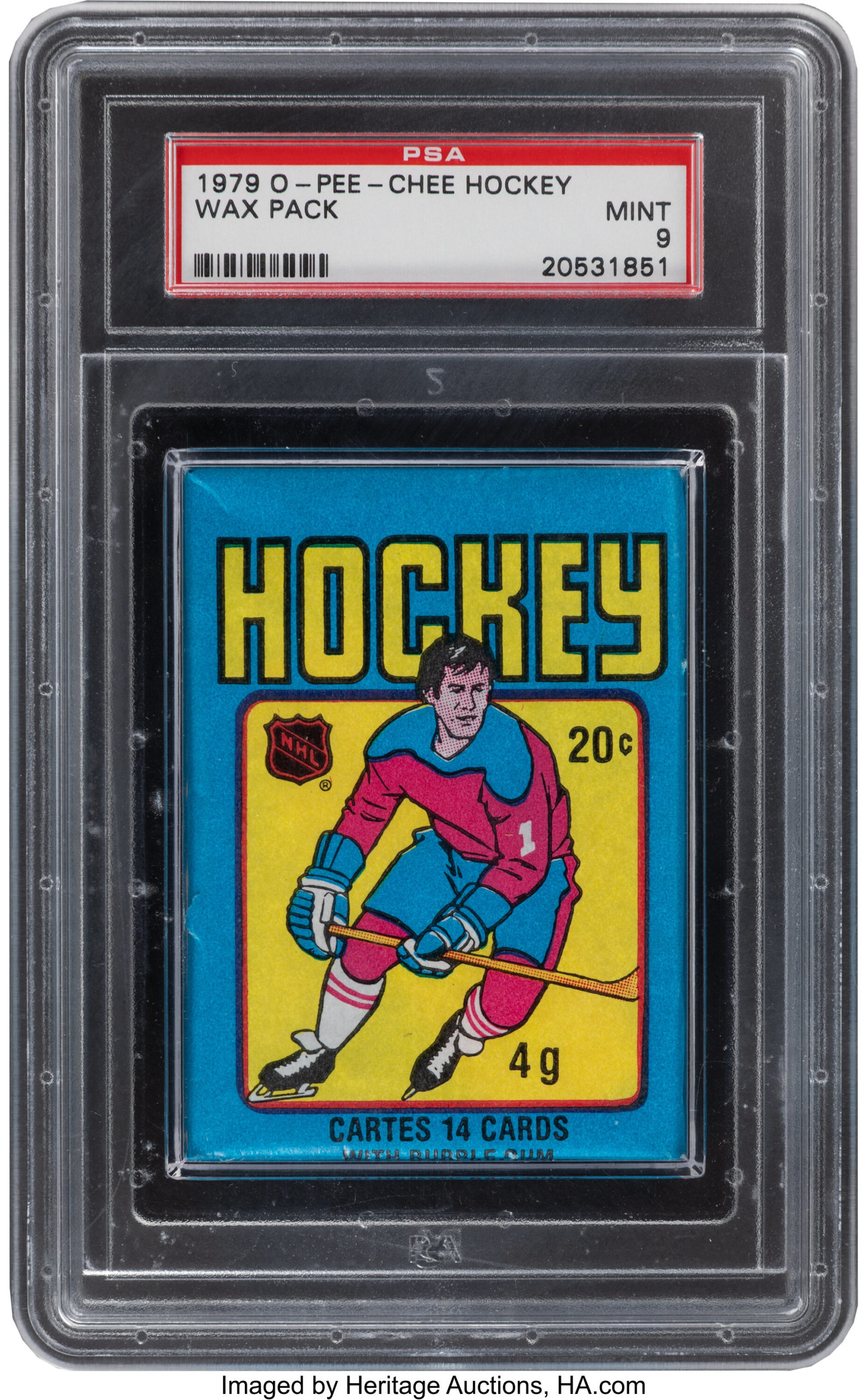
In the 1990s, the number of Wayne Gretzky fakes on the show floor was a common topic of discussion among dealers, hobby insiders and the hobby media at both the National and the Expo in Toronto, which was and still is the largest hockey card show in the world.
The Gretzky forgeries were easy to spot by the trained eye. Each Gretzky O-Pee-Chee RC has a yellow ink blemish on the Great One’s shoulder.
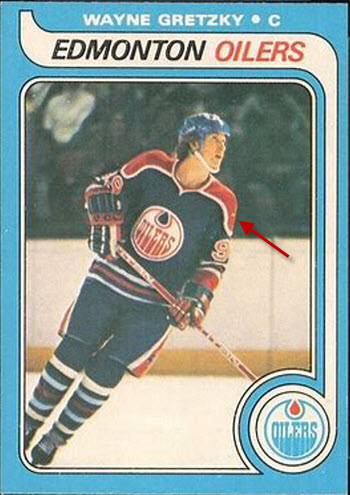
The blemish is not an on-press problem. The likely problem with the card would have been a small scratch or heat bubble on the negative. Back then, in the pre-digital days of four-color separations, negatives were “opaqued” before the plates for the presses were burned. Imagine a little bottle of brown nail polish applied with a tiny brush to the negatives to cover up tiny scratched and marks. There would be four sets of negatives – black, yellow, cyan and magenta. That would sound familiar if you are a one-of-one plate collector.
There are “targets” on the sides and ends of the negatives, that are matched up precisely to make sure the colors are clean and crisp. If you see a card from that era that is fuzzy and looks like you needs 3-D glasses to see it, the targets were slightly off.
Whoever opaqued the yellow color negative in the O-Pee-Chee first form totally missed a spot and let one slip past the goalie. As much as it resulted in a flaw, that mark is the greatest gift O-Pee-Chee could have produced to prevent forgeries. It was like a counterfeit-proof hologram before its time.
In addition to the cards having chipped ink along the edges, there is always a centering issue with the 1979-80 O-Pee-Chee set. The centering isn’t as bad as the 1985-86 O-Pee-Chee set, but it’s certainly problematic. There are a lot of cards from that set that have 60/40 centering.
If you look closely at the two PSA 10 Gretzky RCs out there, they really don’t look like 10s when you examine them. However, they are 10s, and there are only two of them. Both cards are worth well over a million dollars.
It is doubtful that the new owner of the case would rip open packs looking for a couple dozen raw Gretzky’s. While mainstream speculation is that the contents of the case could be worth millions, it’s doubtful. More than 10,000 Wayne Gretzky O-Pee-Chee RCs have been graded, and only two exist. There are also fewer than 100 PSA 9s out there.
While the PSA 10s are million dollar cards, the PSA 9s are worth about ten percent of the 10s. The PSA 8s are worth about ten percent of the 9s, or about one percent of the 10s.
This result is a can’t win scenario. If the owner of the case pulls five or six Gretzky cards that would have a grade of 10, then the value of each of the existing 10s could go down because the population of the cards has increased. If most of the cards, as the statistics would suggest, are graded in the 4-7 range, the owner of the case would have a lot of cards worth between $5-10K.
Beyond the Gretzky card
The 396-card 1979-80 O-Pee-Chee set is one of the most significant sets in hockey card history for a number of reasons. Unfortunately, 395 of the cards are overshadowed by the famous card #18 of Gretzky.
So let’s put the Holy Grail of Hockey Cards aside for a moment and take a look at the rest of the set.
The 1979-80 season saw the NHL grow from 17 to 21 teams. The Edmonton Oilers, New England Whalers, Quebec Nordiques and Winnipeg Jets were all absorbed from the World Hockey Association. The Whalers changed their name to the Hartford Whalers. The league’s other two teams, the Cincinnati Stingers and the Birmingham Bulls, were paid to fold.
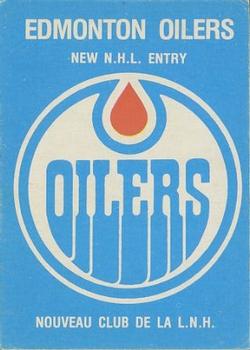
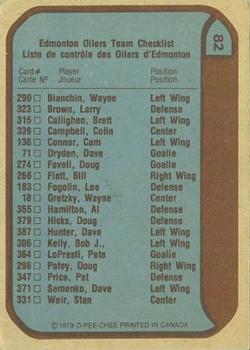
Players from those two teams either entered the NHL Draft, or they signed with the teams that had already owned their NHL rights. Because of the number of WHA players in the draft, the NHL officially changed the name of the draft from the NHL Amateur Draft to the NHL Entry Draft. They also changed the age of eligibility for the draft from 20 to 19, meaning there were literally two years of top draft picks in the same draft.
Without the changes to the draft, Wayne Gretzky and Mark Messier would not have been eligible to play in the NHL until the 1981-82 season. Messier had played for the Cincinnati Stingers in 1978-79 and was selected by Edmonton in the third round of the draft.
Gretzky was expected to be in the 1979 draft, but his contract with the Oilers was a personal services contract with Oilers’ owner Peter Pocklington. The Oilers were allowed to keep Gretzky, but the price was that they dropped to 21st in the draft order among the 21 teams. Had Gretzky been in the draft, the Colorado Rockies would have selected him. Had that happened, the Rockies may have never moved to New Jersey, and the Edmonton Oilers may have never been a 1980s dynasty.
Four of the first six players taken in the 1979 NHL Draft were WHA players. Rob Ramage of Birmingham went first to the Colorado Rockies, Mike Garner of Cincinnati went fourth to the Washington Capitals, and Birmingham teammates Rick Vaive and Craig Hartsburg went fifth and sixth to the Vancouver Canucks and Minnesota North Stars.
Because some of the WHA players entering the league had cards in the late 1970s O-Pee-Chee WHA sets, their 1979-80 O-Pee-Chee cards were not given the RC designation in the hobby. That meant that Hall of Famer Mark Howe’s card from that set is not an RC. Another card following into that category is the first NHL card of Mike Rogers.
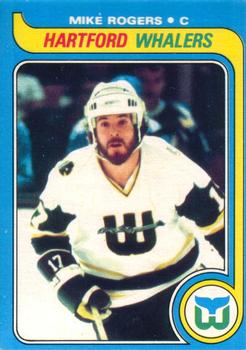
Other Hall of Famers in that 1979 draft included Ray Bourque, Michel Goulet, Kevin Lowe, Glenn Anderson and Guy Carbonneau.
Because the draft was only six rounds that year, there were many notable players who were undrafted, including Dino Ciccarelli, Charlie Huddy and Tim Kerr.
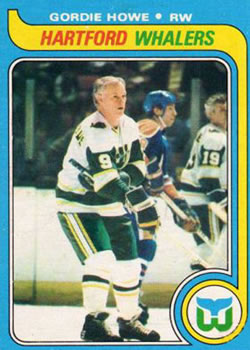
The key cards in the set from the players who came to the NHL from the WHA are the last cards of Bobby Hull and Gordie Howe. The fact that Howe’s last card is in the same set as Gretzky’s rookie card Is poetic. Aside from Howe and Hull, other last cards in this set are legendary Montreal Canadiens goalie Ken Dryden, and Hull’s longtime Chicago Blackhawks teammate and co-inventor of the curved stick, Stan Mikita.
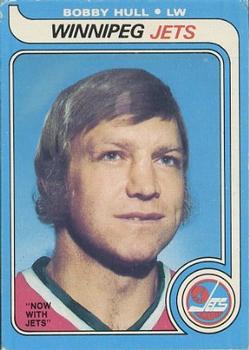
The number of Hall of Famers in this set is staggering. Aside from the players with their last cards, the list includes Mike Bossy, Marcel Dionne, Guy Lafleur, Bryan Trottier, Brad Park, Larry Robinson, Denis Potvin, Tony Esposito, Gerry Cheevers, Steve Shutt, Serge Savard, Darryl Sittler, Jim Rutherford, Bobby Clarke, Clark Gillies, Vaclav Nedomansky, Guy Lapointe, Bill Barber, Lanny McDonald, Bob Gainey, Gilbert Perreault, Bernie Federko, Mark Howe, Phil Esposito, Jean Ratelle, Rogatien Vachon, Billy Smith, Dave Keon and Colin Campbell.
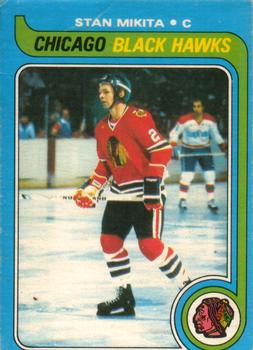
Even though the 1979-80 NHL season was one of the best ever for rookies, those great rookies had rookie cards in the 1980-81 O-Pee-Chee set the following year. Despite that, there were still 60 rookie cards, including Gretzky, in the 1979-80 set.
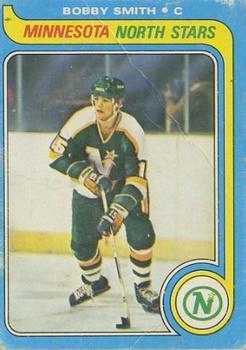
None of that rookie card class are Hall of Famers, but there are some big names. One of the most sought after cards in the set when it was live was the rookie card of Bobby Smith. He was the first overall pick of the Minnesota North Stars in the 1978 draft, and was coming off a rookie campaign of 30 goals and 44 assists for 74 points. Smith had over 1,000 points in his storied career, and many believe he should be in the Hall of Fame.
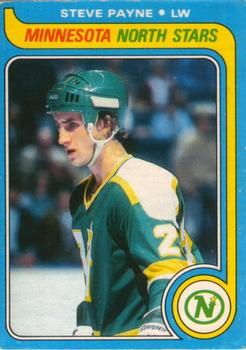
Smith’s North Stars teammate Steve Payne, who also played with Smith in junior with the Ottawa 67s, also has a rookie card in that set. While they were dominant as linemates in junior, they also were in the NHL. During the 1979-80 season, Payne ended with 85 points while Smith had 83.
John Tonelli and Charlie Simmer are about as close to being Hall of Famers as you can get. Tonelli was part of the New York Islanders dynasty of four straight Stanley Cups and had his number retired. Simmer was a member of the Los Angeles Kings’ Triple Crown Line.
Rugged defensemen Joel Quenneville and Barry Melrose were solid NHL players with rookie cards in that set, but their cards became more popular when they became coaches and, in Melrose’s case, a nationally known media personality.
Other prominent rookie cards in the set include Don Maloney, Thomas Gradin, Wayne Babych, Morris Lukowich, Ryan Walter, Ken Linseman, Greg Millen, Glen Hanlon, Brian Engblom, Dave Semenko and Dave Hunter.
Overall, 1979-80 O-Pee-Chee Hockey is perhaps the most significant hockey set ever produced. Obviously, that is because of the Wayne Gretzky rookie card, but the set also reflects one of the most significant seasons in hockey history.
—-
1979-80 O-Pee-Chee hockey cards on eBay
