
Walter Payton’s brother once said that the Hall of Fame running back was a great white shark in a previous life.
“If he stops moving forward, he will die,” Eddie Payton said.
Jim Brown, whose NFL career rushing record Walter Payton would break 40 years ago this week, called the Bears great a gladiator.
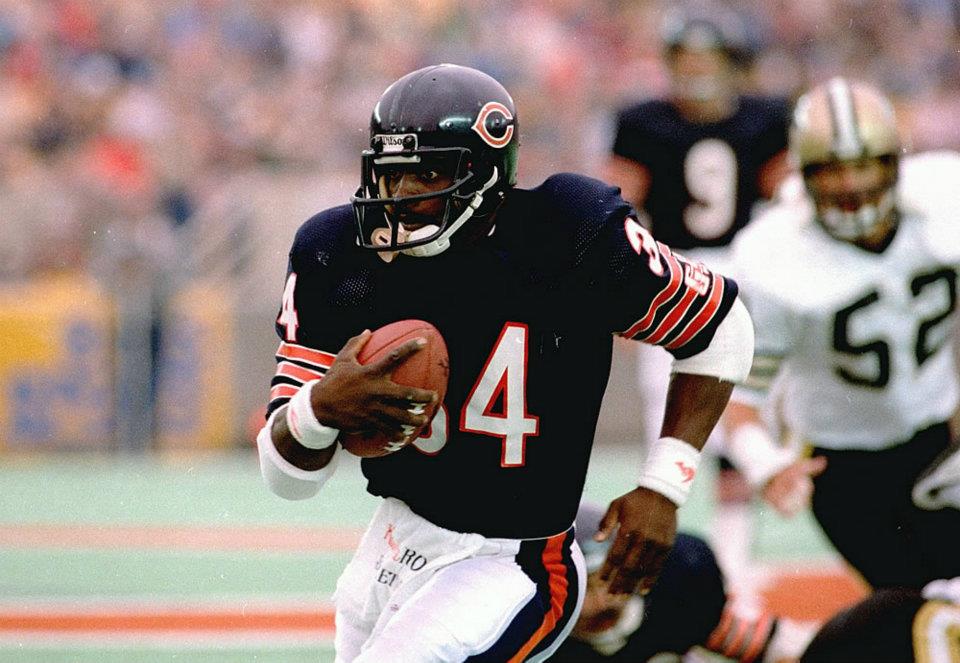
NFL fans and football card collectors called him “Sweetness” — and with good reason.
On Oct. 7, 1984, Walter Payton kept moving and became the NFL’s all-time leading rusher. He broke Brown’s record of 12,312 yards on the second play of the second half during the Bears’ 20-7 victory against the New Orleans Saints at Soldier Field.
The play was called “Toss 28 Weak.” Payton took a pitch from quarterback Jim McMahon and ran behind fullback Matt Suhey and left guard Mark Bortz. Payton gained 6 yards on the play to move past Brown. He would finish with 154 yards on 33 carries for the Bears, snapping a tie with Brown as he rushed for at least 100 yards for the 59th time in his career.
“When you’re blocking for Walter, you don’t have to be Superman,” Bortz said after the game. “He’s Superman.”
Payton had some interesting — and unusual — cards during his NFL career. Here is a look at some familiar ones to collectors, while others are a bit more obscure or niche-driven. Either way, it is a fun look at a sweet career.
1976 Topps (No. 148)
Every conversation about Payton cards has to begin with his first, issued by Topps in its 1976 set. The card featured Payton smiling in an oversized mug shot. He had played in 13 games during the 1975 season, starting seven times rushing for 679 yards and scoring seven touchdowns. The 1976 season would be Payton’s breakout year, as he started 14 games and led the league with 311 carries, rushed for 1,390 yards and scored 13 touchdowns.
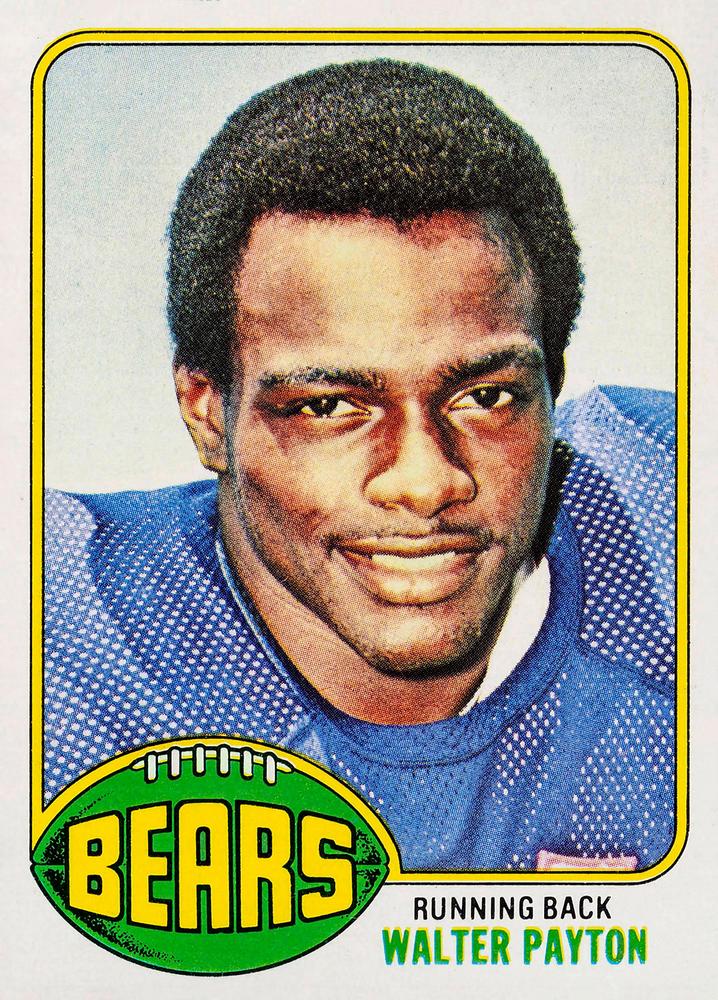
His rookie card is not difficult to find in high grade, but centering issues have limited PSA 10 specimens to a mere 55 examples. More than 900 cards have been graded PSA 9.
1976 Coke Bears Discs
This 22-piece issue features only members of the Bears, and it is believed that distribution was limited to the Chicago area. The discs are not numbered and can be found in two versions — with hang tabs or without. Discs with the tabs measure 5¼ inches by 3 3/8 inches, while the tab-less discs measure 3 3/8 inches in diameter.
The backs of the discs feature the slogan, “Coke adds life to … halftime fun.”
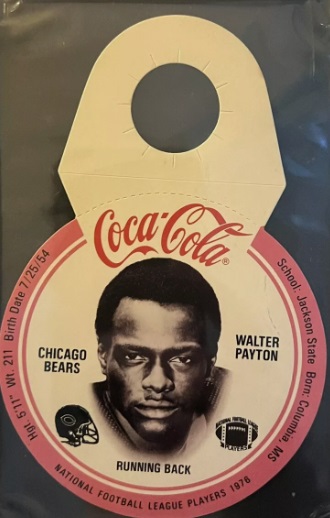
PSA has graded 102 of them: 65 with tabs and 35 without. Of the discs with tabs, 31 submitted have come back as Gem Mint 10s. For discs without tabs, 18 carry 10 grades.
1978 Fleer Team Action No. 7
The 1970s were an odd time for football cards. Topps, for example, had a license with individual football players but not with the NFL teams. That meant that team logos were airbrushed from the card. Meanwhile, Fleer was licensed by the NFL, but not by the NFL Players Association. That meant Fleer could not mention the players’ names, although they could use photography.
The 1978 Fleer #7 features a great shot of Payton on the move against the Detroit Lions.
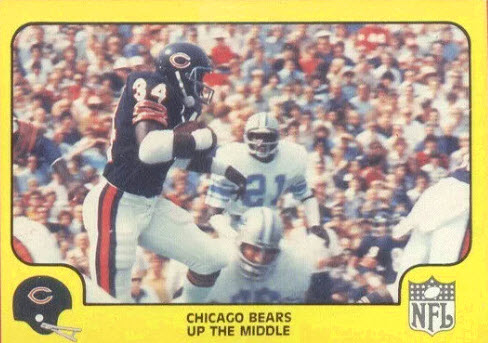
Payton appears a few different times during the years in which Fleer packaged cards with team logo stickers and while he’s not named, the photos are generally pretty good.
The card back is maddeningly frustrating. “One of their backs was the season’s leading runner,” it reads. And then there is a grammatical error — “… he also lead the league in scoring with 96 points.”
Copy editors worldwide are smacking their foreheads in disgust.
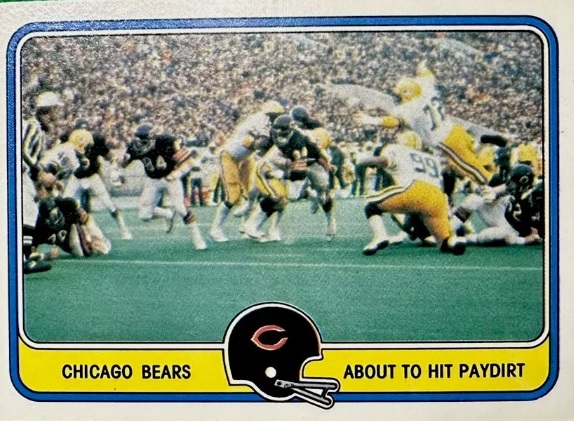
The 1981 card shows him headed for the end zone against arch-rival Green Bay at Soldier Field but as great as he had become, there could be no mention of him. The focus was all about the NFL teams–not the players.
1981 Chicago Police Department
The Bears were one of several NFL teams that had card sets sponsored by the Kiwanis Club and local law enforcement. The Bears’ version contains 24 unnumbered cards, including Payton, which measure 2 5/8 inches by 4 1/8 inches. The card fronts feature a Bears helmet along with the Kiwanis Club logo. “Chicago Bears Tips” are printed on the backs of the cards.
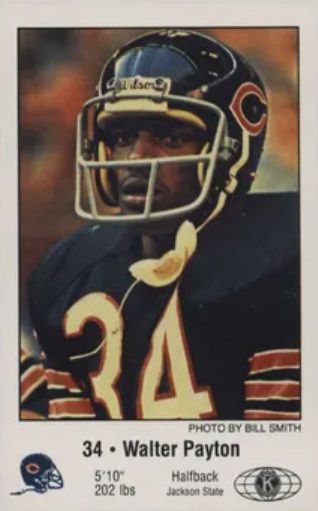
Limited regional distribution and Payton’s popularity have made these very attractive to collectors.
There have been 143 cards of Payton from this set submitted to PSA. Of those, 23 earned a gem-mint grade and 75 are PSA 9s.
1982 Topps (No. 303)
Remember Bortz comparing Payton to Superman? The 1982 Topps football set featured an “In Action” card of Payton flying through the air to gain yardage against the Tampa Bay Buccaneers.
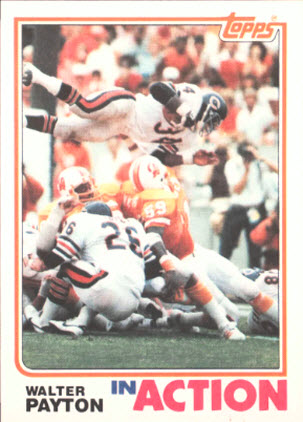
The photo is one of the best Topps ever utilized on a football card.
Payton is prominently featured in three other cards in the 1982 set. There is one with his brother Eddie (No. 269), Bears team leaders (No. 292) and his regular-issue card (No. 302). Payton can also be seen standing next to Suhey on the fullback’s regular-issue card (No. 305).
The “In Action” card can be found in high grades, with 149 of them earning PSA 10 status.
1984 7-Eleven Discs
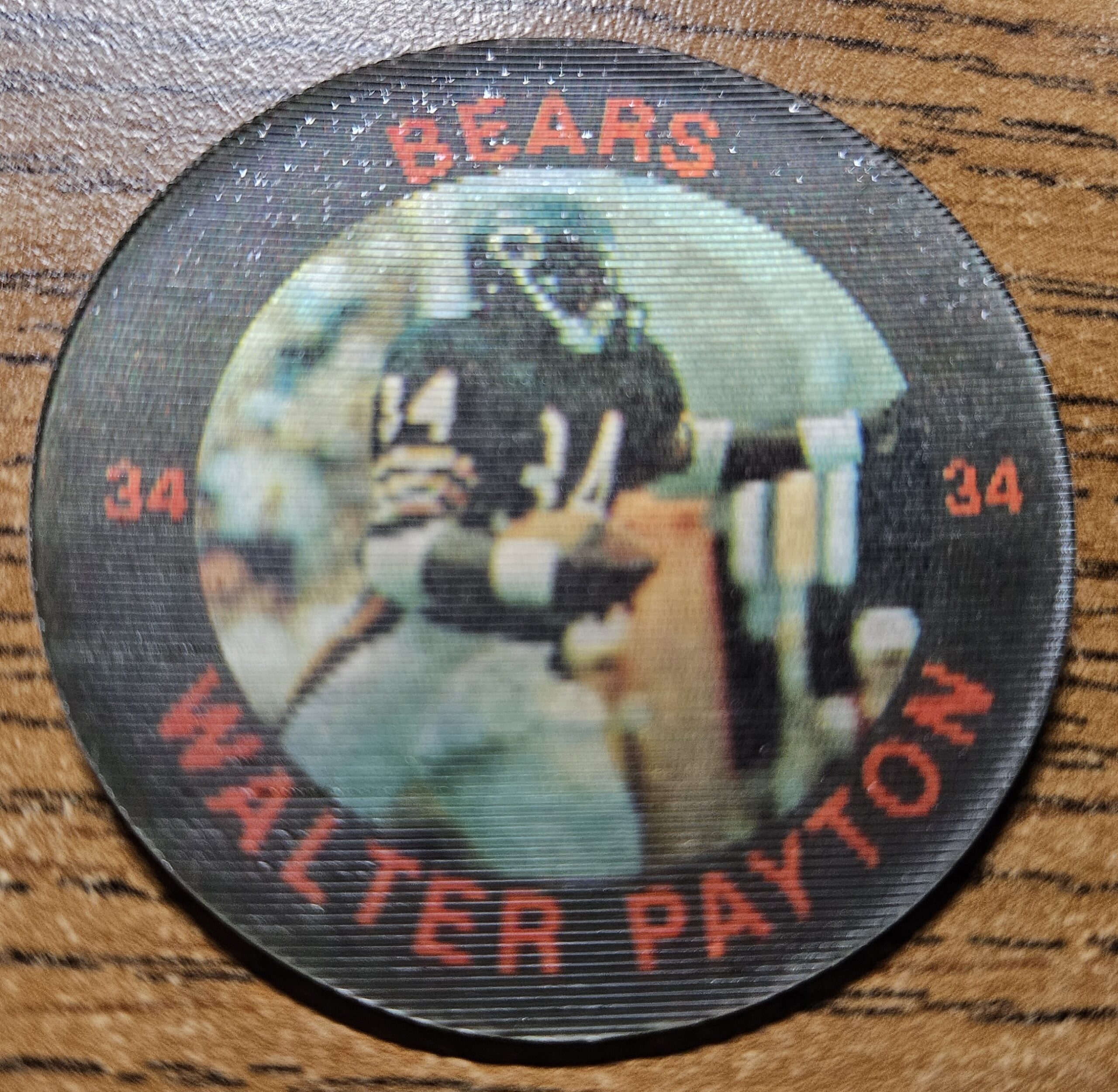
These discs, measuring 1¾ inches in diameter, were available at participating 7-Eleven convenience stores. The set included 40 cards, with 20 in designated “East” and “West” regions. Payton can be found twice in the set – on disc No. 6E and No. 7W.
The discs have a portrait and an action figure on the front, with each becoming fully visible as you turn it in your hard.
The back contains career statistics, pro honors, a Slurpee logo (honoring 7-Eleven’s signature fountain drink) and the year 1984.
1985 Topps NFL Star Set (Rack Pack Glossy No. 8)
This glossy set contained 11 cards. Cards were printed on heavy stock and could be found in rack packs of 1985 Topps Football. The card front of Payton showed an action shot of the Bears’ great looking for running room. The card backs featured red and blue type, with an NFL logo at the top, the players’ association logo at the bottom and the player’s name in large blue block letters.
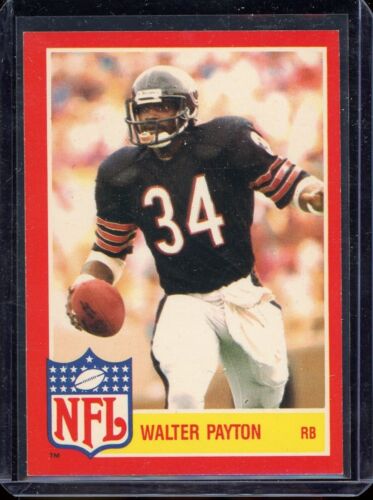
1985 McDonald’s Bears (No. 34)
During the Bears’ run to Super Bowl XX, McDonald’s restaurants in the Chicago released a set of 32 players. This appeared to be a test set since the fast food giant issued cards of all 28 teams in the 1986. For the Chicagoland version in 1985, there were three sets of perforated tabs — blue, orange and yellow. Each tab specified a specific postseason game.
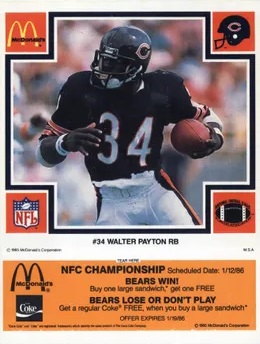
The cards measured 4½ inches by 5 7/8 inches with tabs; without tabs the cards were 4½ inches by 4 3/8 inches.
The cards are numbered to each player’s jersey.
1986 Jeno’s Pizza Rolls (No. 12)
Jeno’s Pizza Rolls inserted cards inside boxes of its product in 1986, each contained in cellophane wrapper to keep it away from the frozen snack within. The set included 58 cards, with two players from each NFL team represented. The final two cards were used for a Terry Bradshaw “playbook.”
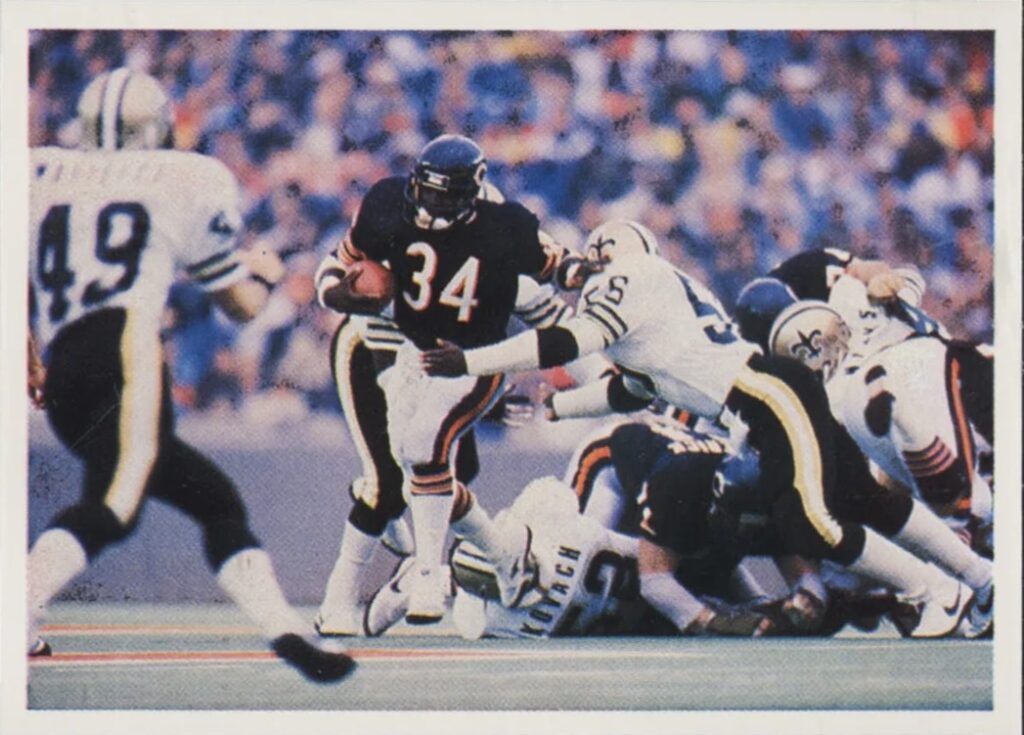
The fronts carry no text. Payton is shown applying a stiff arm to a New Orleans Saints defender during the game in which he broke Brown’s record two years earlier. The back mentions the record setting day.
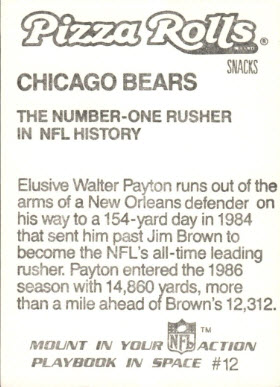
Of the 70 Jeno’s Payton cards submitted to PSA for grading, only six came back with a 10 grade. Another 28 are PSA 9s and there are 22 PSA 8s.
1986 Bears/Patriots Police cards (No. 3)
This 17-card set was issued after the Bears trounced the New England Patriots 46-10 in Super Bowl XX. Payton rushed 22 times for 61 yards in the rout, although was denied a chance of scoring a touchdown when William “The Refrigerator” Perry was given the ball near the goal line.
The cards measure 2 5/8 inches by 4¼ inches and boast a photo of the player on the front. Payton is shown standing on the sidelines, wearing a headband and a towel embroidered with “Sweetness.” Appropriate.
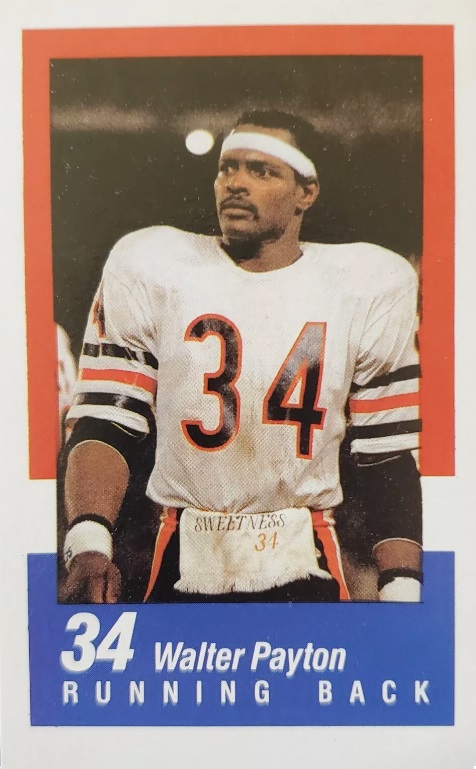
Payton’s card is easily the most valuable one in the set, with 109 sent to PSA for grading. Only one card was returned as a 10.
The card backs offered a safety tip, too.
Final fun fact
Here is one final fun fact about Payton’s record-breaking day in 1984. More than 12,000 fans stayed away from Soldier Field on that gloomy October afternoon, probably to watch baseball. The Chicago Cubs were playing Game 5 of the National League Championship Series in San Diego against the Padres and were hoping to reach the World Series for the first time since 1945. It did not happen, as the Padres advanced with a 6-3 victory to win the best-of-five series.
Payton, meanwhile, would receive a congratulatory telephone call from President Ronald Reagan, who was aboard Air Force One en route to a debate with Walter Mondale.
Payton retired after the 1987 season, having rushed for 16,726 yards. His rushing record was broken by Dallas Cowboys running back Emmitt Smith on Oct. 27, 2002, who rushed for 11 yards in the fourth quarter against the Seattle Seahawks. Smith would end his career with 18,355 rushing yards.
Payton died on Nov. 1, 1999, but his legacy endures. He was inducted into the Pro Football Hall of Fame in 1993.