
Hall of Famer Jack Dempsey’s long, hard road to the world heavyweight title began in 1914. Losses and draws in the early years of his career delayed potential title opportunities. But in 1919, Dempsey finally got his chance at the title in a Fourth of July bout against then champion, Jess Willard.
The fight did not live up to its billing. Dempsey scored a bruising win over Willard that was so decisive that it evoked claims of Dempsey wearing loaded gloves. Nothing of that sort was ever proven and Dempsey would go on to defend the title for more than seven years. That timeframe, however, is a bit misleading as Dempsey only granted seven defenses over that span.
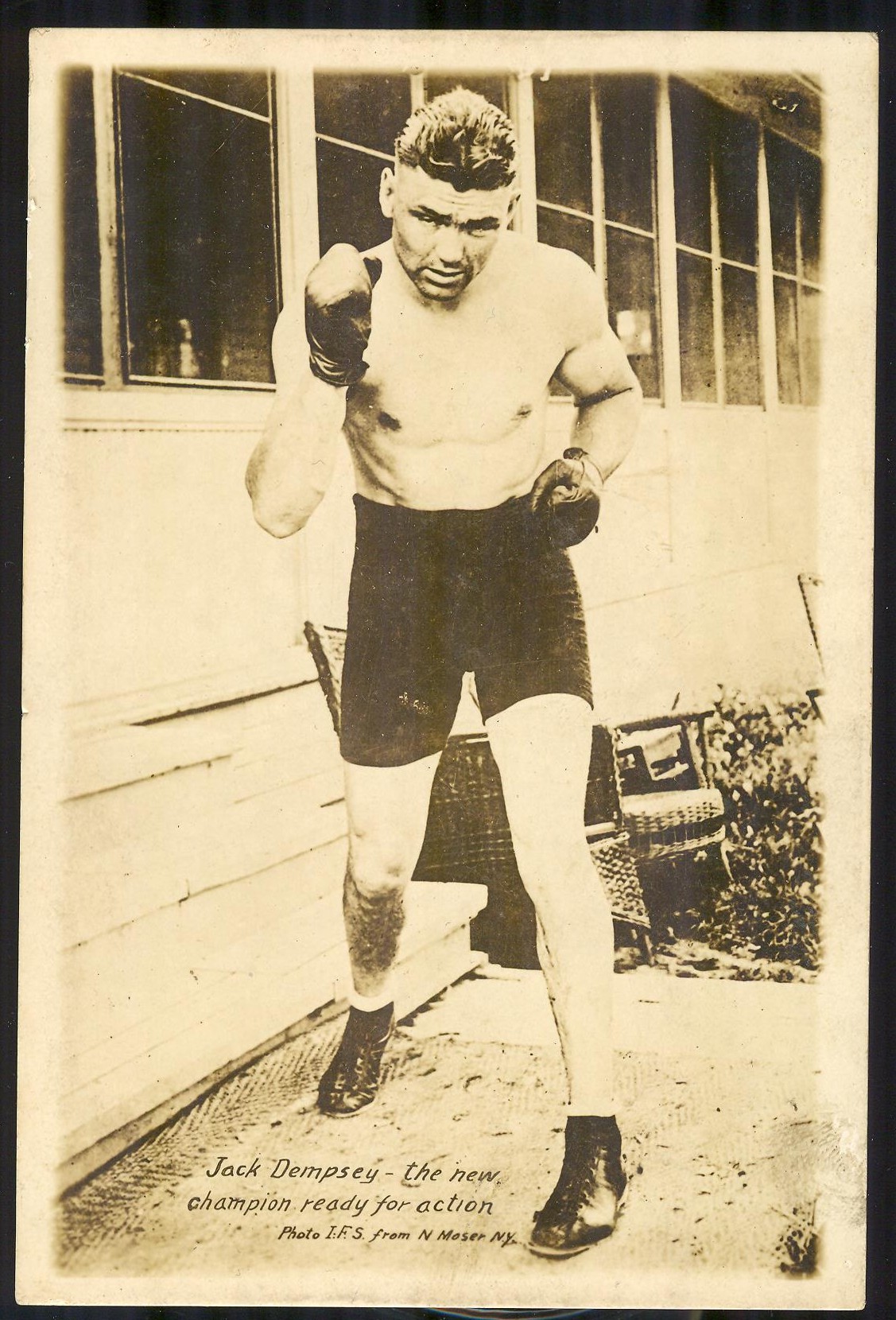
It would be more than a year before he would first defend the title against Billy Miske. While he did fight Bill Brennan in December a few months later, he would fight only once in 1921, scoring a knockout over Georges Carpentier, before a two-year break. Dempsey would defend the title twice in 1923 but then took another three-year break from any other defenses, only participating in some exhibitions and doing some acting. For five of Dempsey’s seven years as champion, he would have no title defenses.
Following that three-year break, Dempsey would lose the title to Gene Tunney in 1926. After a win vs. Jack Sharkey the following year, Dempsey would earn a rematch with Tunney before losing again in the infamous ‘Long Count’ match. The fight prompted his retirement from professional boxing.
Jack Dempsey’s 1920 Cards
Unsurprisingly, Dempsey became a household name after winning the heavyweight championship in 1919. While Dempsey isn’t known to appear on any issues prior to his fight with Willard, he entered the card market in a big way in 1920. PSA has Dempsey appearing in a dozen sets that year and in nearly 30 from 1920-23. And because so many obscure international boxing sets existed in the time period, he likely is found in even more sets.
The 1920 cards have been a hot topic of discussion because they are almost universally accepted as Dempsey’s rookie cards. Many of his 1920 cards are from the W519/W521 strip card sets, which follow the format of the baseball strip cards using those same American Card Catalog designations. The others are the W529 strip cards resembling the format of the W516 baseball strip cards.
Interestingly enough, there has been confusion with the specific years of those cards as some different dates have been assigned to W529 strip cards.
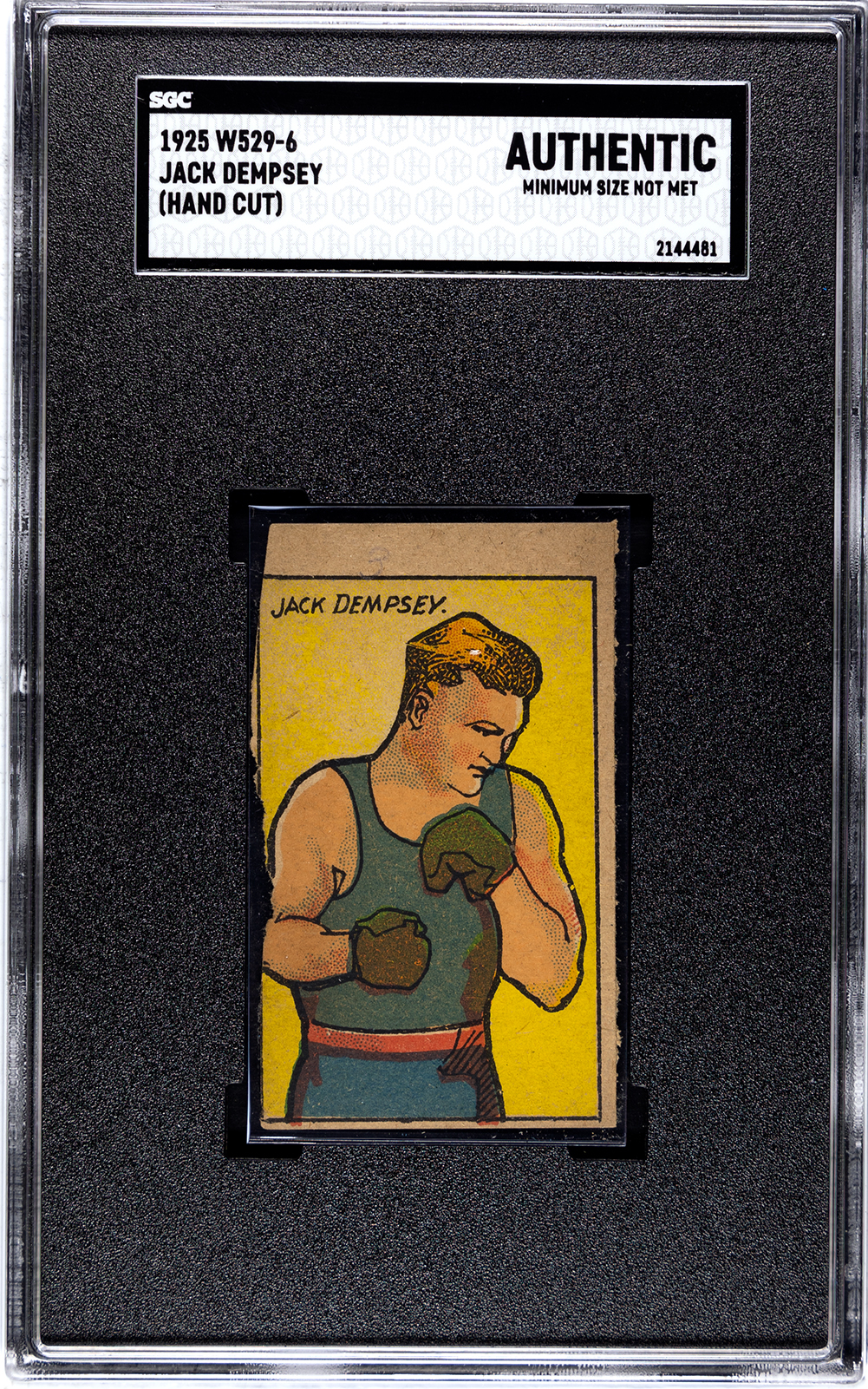
For example, SGC has curiously graded these as 1925 cards, even as they follow the same formats of the various 1920-21 W516 baseball strip cards (see the example above). To almost all collectors knowledgeable with these sets, though, they are considered to be from the same years as the baseball cards. It is worth pointing out that SGC has also graded them as 1920-29 cards. PSA maintains they are a 1920 issue.
Finally, it is important to note that Dempsey does indeed have some 1919 cards. He is featured in a set of postcards along with Willard with cards picturing images from the fight. While these may be considered as rookie cards by some collectors, they do not typically command high values. More importantly, they are generally passed over because they feature both fighters and because they are postcards instead of traditional trading cards. Despite their presence, the various 1920 cards featuring Dempsey have still traditionally been defined as rookie cards.
Underwood & Underwood Cards
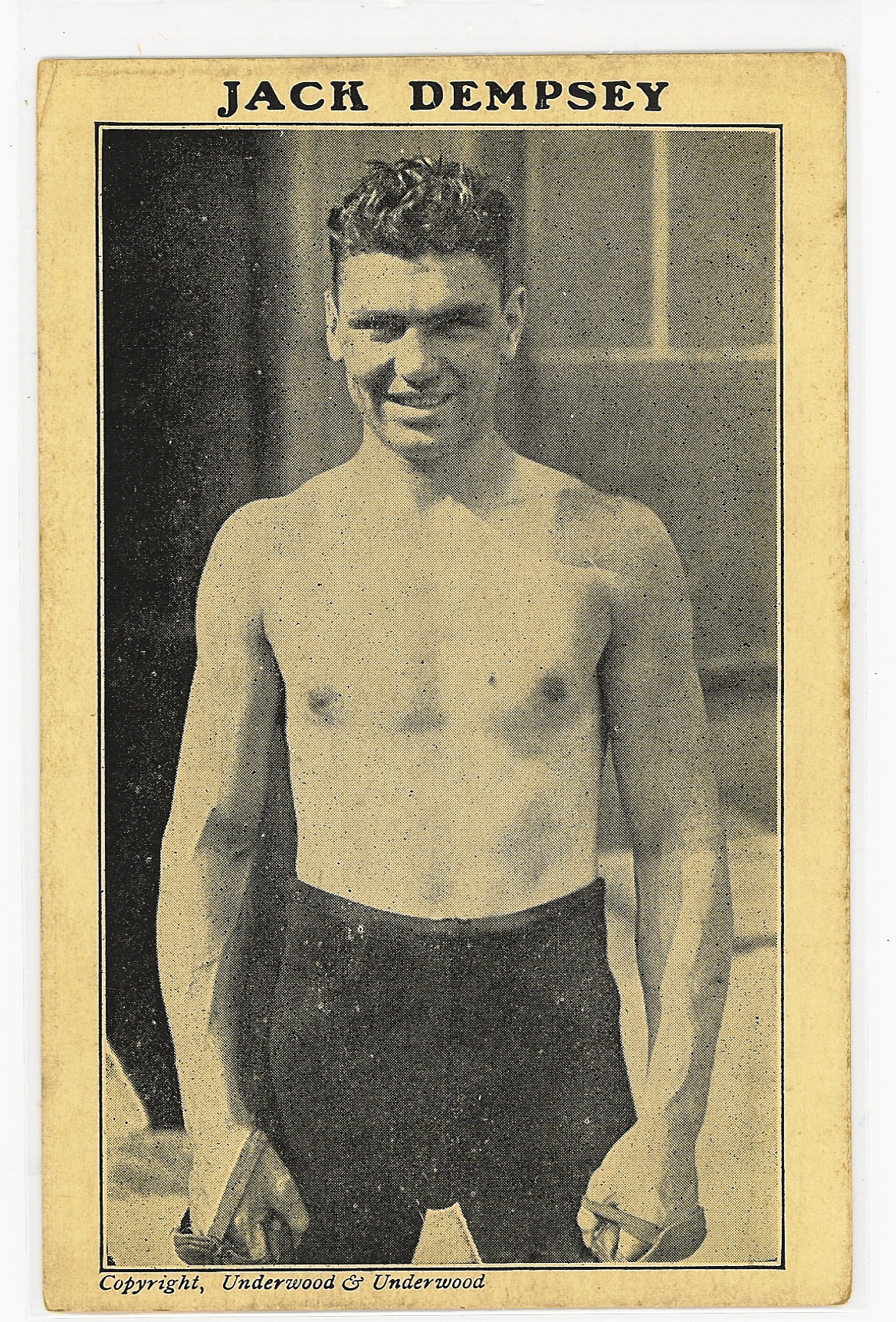
The most desirable of Dempsey’s American rookie issues is generally viewed as his Underwood & Underwood photo card.
The Underwood & Underwood name is particularly well-known to collectors of photographs. The company founded by two brothers was known for first issuing stereoscopic cards and, later, photographs for news outlets. Numerous press photos were issued by the company to media outlets using them for publications.
The Underwood & Underwood photo cards are roughly postcard-sized but are definitively not postcards, featuring only blank backs instead. These black and white cards picture each fighter with their name in bold lettering at the top. They are identified in the bottom border as being copyrighted photos from Underwood & Underwood. Printed on a thicker cardstock, they are very similar to Exhibit cards, which would become popular in the 1920s.
Dating of the Cards
The cards are often recognized as a 1920 creation. But they seemingly should be classified as 1919 cards. The reason? The modest two-card checklist featuring only Dempsey and Willard.
What sense would it make for the Dempsey and Willard cards to be issued in 1920 a year after the fight between the two occurred? The pair did not fight again and Willard practically rode off into the sunset afterwards. He essentially retired before returning in 1923 for a pair of fights prior to retiring for good.
The cards also appear to feature photography from 1919. While I have not been able to track down the exact age of the photo used for Dempsey’s card, Willard’s card pictures him wearing the same training outfit he wore in 1919 while training for the Dempsey fight. The two cards seem to have been issued as a precursor for the fight or, at latest, immediately afterwards. Printing them a year after the fight took place would make little sense.
Where did the 1920 date originate? Well, interestingly, PSA lumps these two cards with other Underwood & Underwood cards issued for Dempsey’s fight with Carpentier. The problem with that is two-fold.
First, the two types of cards look nothing alike and certainly are not part of the same set. The Dempsey-Carpentier cards are even numbered while these are not. Second, the Dempsey-Carpentier cards cannot possibly be from 1920, either. That’s because they picture scenes from the fight that did not occur until 1921.
Underwood & Underwood Rarity and Pricing
Whether they are from 1919 or 1920, the Underwood & Underwood cards of Dempsey are considered as a rookie card. They are also quite rare. Despite the fact that the cards are valuable, PSA has only graded a total of 24 to date. SGC has graded 15.
The cards are not terribly expensive and, given the rarity and the importance as a rookie card of such a prolific fighter, one could even say they are a bit underrated. Low-grade examples typically start in the $200-$400 range. Better examples can sell for $1,000 or more.
Despite that thicker size, it is virtually impossible to find these cards in high-grade condition. No Dempsey or Willard card has been graded higher than a PSA 4 or SGC 4.
