
Two blocks from Rockefeller Center’s Christmas tree, the euphoria at a bar upstairs matched the season’s Yuletide spirit. On a November evening in New York, BC Vintage was hosting its sixth Collectors Exchange event. Company founders Chris Brigandi and Chris Caserta invited hobby heavyweights in various memorabilia categories to share insights and stories. About 50 collectors, some traveling long distances, were on hand.
Leading off was Andrew Eckert, the director of business operations at Fanatics Live & Fanatics Collect. Since relaunching PWCC through Fanatics Collect four months ago, the company has been selling 10,000 to 12,000 cards per week. Eckert also touted Fanatics Live, the company’s livestreaming arm where box breaks are conducted by sellers who offer spots in everything from $75 boxes to those that sell for thousands. 2024 Topps Chrome Update breaks with collectors looking for MLB Debut Patch cards–like the well publicized Paul Skenes— has been popular.
“You have his MLB Debut Patch worn on the field in his first game, a pinnacle moment,” Eckart said. “Then you take that patch and he autographs it. Skeenes has become the de facto best chase card in the hobby.”
Brigandi asked him what the primary goal is for the company that will eventually own licenses for the NFL and NBA as well as the Topps Company that it now owns. “Fanatics wants to connect the ecosystem of different kinds of collectors, from the live collector to the pure Topps collectors, through our synergy. It’s the power of all these things.”
Since serving as Notre Dame’s Fighting Irish equipment manager in college, Eckhart has become a fervid collector of his alma mater. He owns every style of the school’s jersey ever worn— 250 in all. Eckhart brought a a green jersey with a blue stripe on the sleeve worn just one game by a punter in 1983, which he bought from a local collector in South Bend.
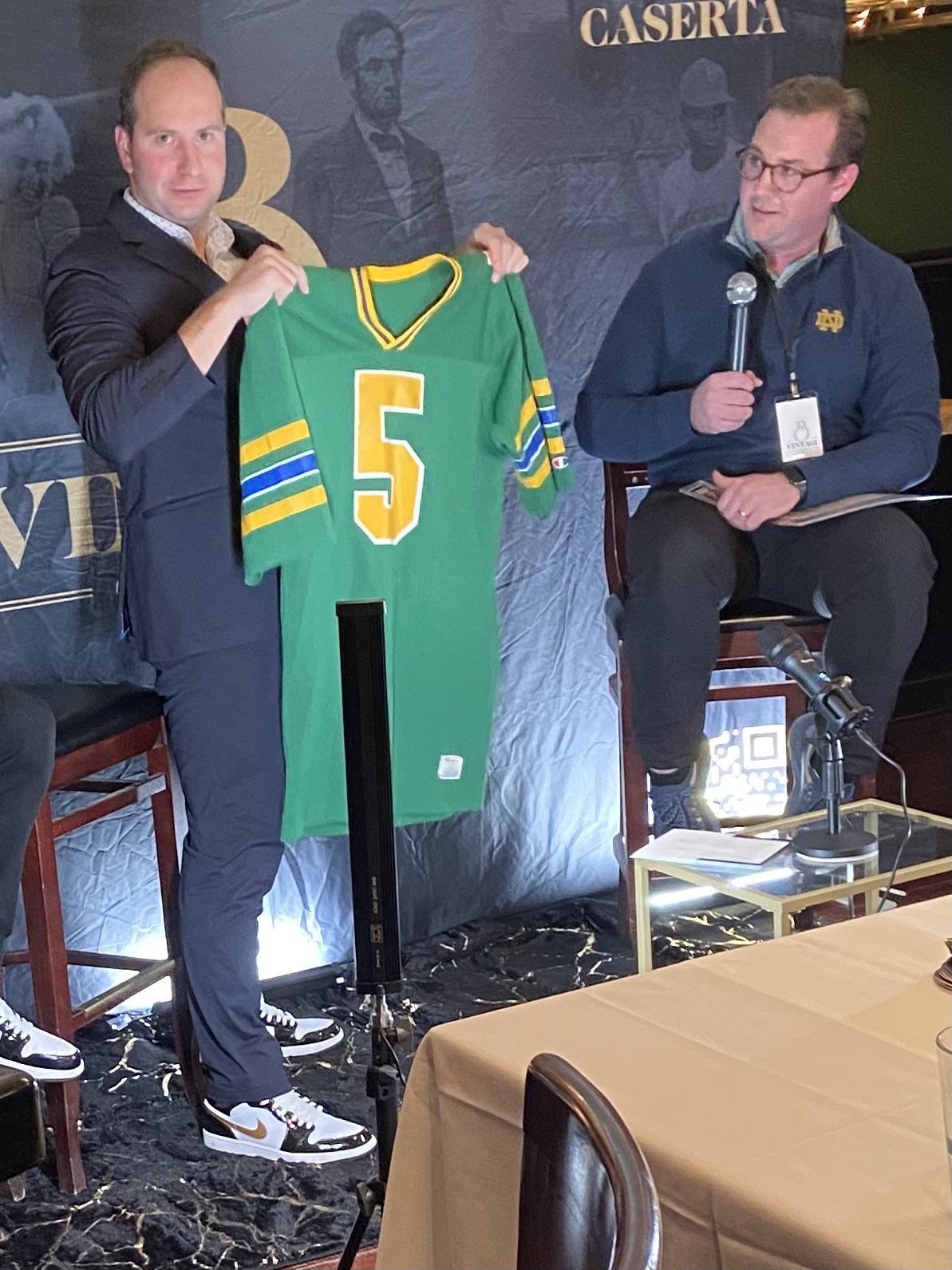
Each of his four vintage paper ballots for the Heisman Trophy was mailed out to 100 journalists before the digital age, including one from 1956 bearing Hall of Famer Paul Hornung’s name. On top of that, he asked each living Notre Dame coach for a handwritten play. Lou Holtz complied with a reverse play, detailed by x’s and o’s, that enabled Rocket Ismail to score a touchdown.
Khyber Oser, the director of vintage memorabilia and photography at Goldin, co-wrote with Henry Yee, PSA/DNA’s photo authenticator and uber collector Marshall Fogel, the 2002 book that established the “Type” system. Type 1 original photos of popular sports card images have skyrocketed in value.
Original Sports Illustrated photos are some of the hardest to find. Oser showed a 1969 Type 1 photo of Celtics Hall of Famer John Havlicek that graced an SI cover. As graded magazines gain traction in the hobby, he believes that such photos will attract broader interest (that photo, colorized by SI, is on the auction market now).
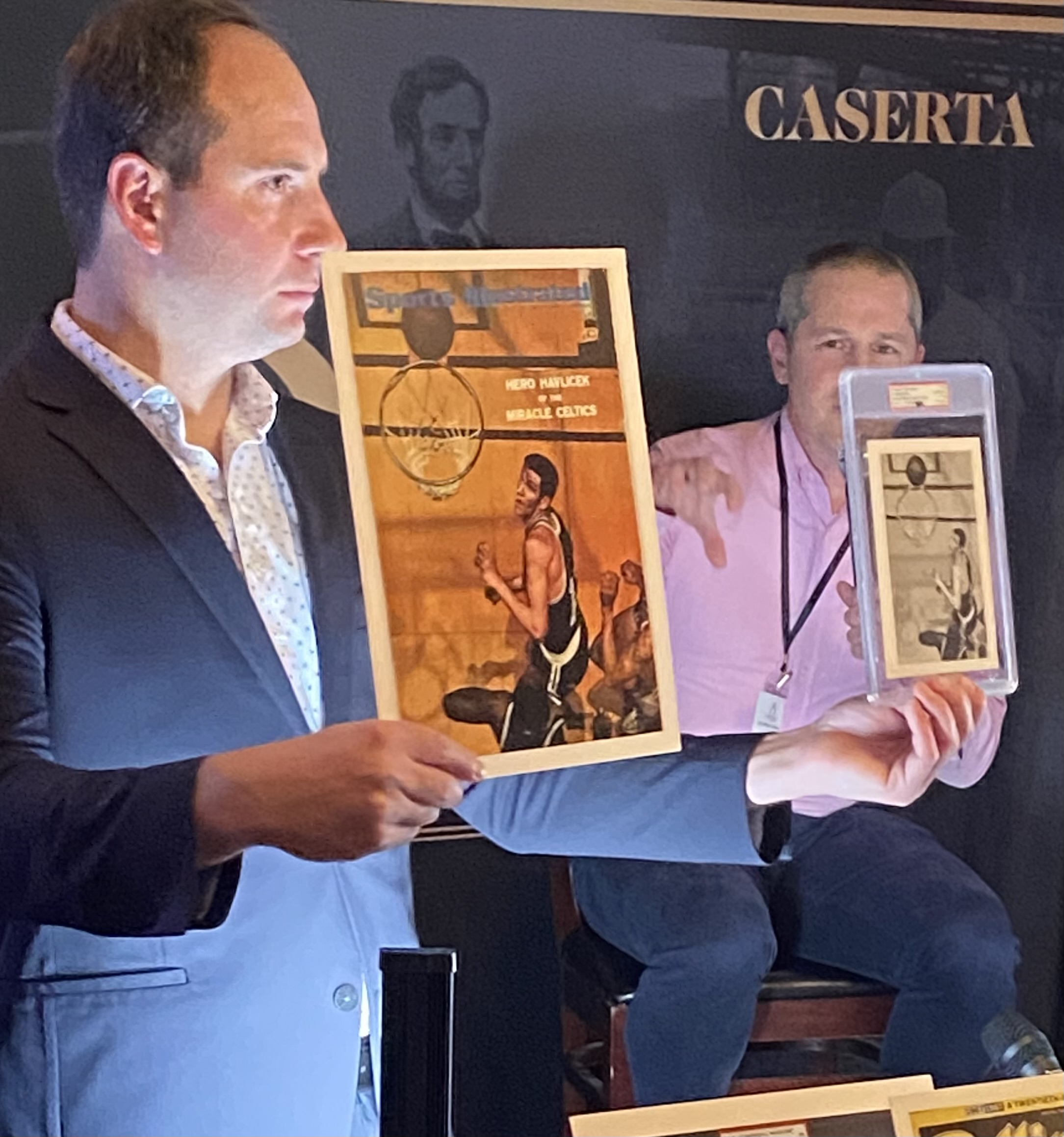
“There’s so much more to photos than cards,” Oser said. “They were used for magazines, posters. premiums. postcards. and programs. Babe Ruth photos were on pinbacks (buttons). His underwear box is a Charles Conlon photo. He and other master photographers had secondary usage. Photos are fine art and tell stories. This crossover is what makes photography even more interesting.”
Osser held up a Type 1 photo of Mantle’s 1950s M114 Baseball Magazine premium. “If you own the premium, you might want the photo,” he said.
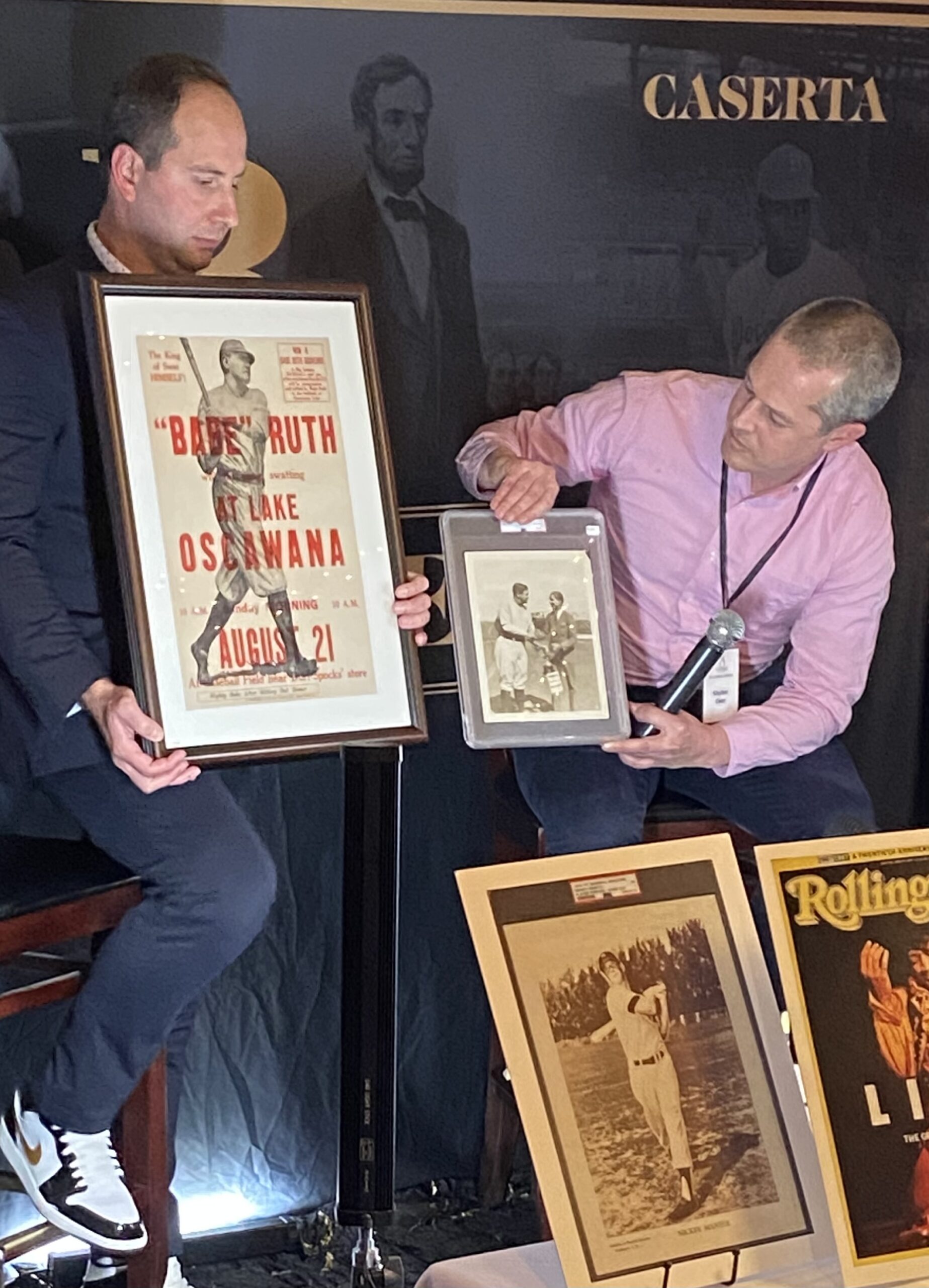
Brigandi shared with Oser and the guests a perfect example of his philosophy. He acquired a striking 1926 barnstorming poster of Babe Ruth at Oscawana Lake in upstate New York. He was examining with a magnifying glass a Type 1 photo of Babe Ruth giving a trophy to a boy in a baseball uniform. The trophy had Oscawana Lake stamped on it, making the photo and poster an ideal pair.
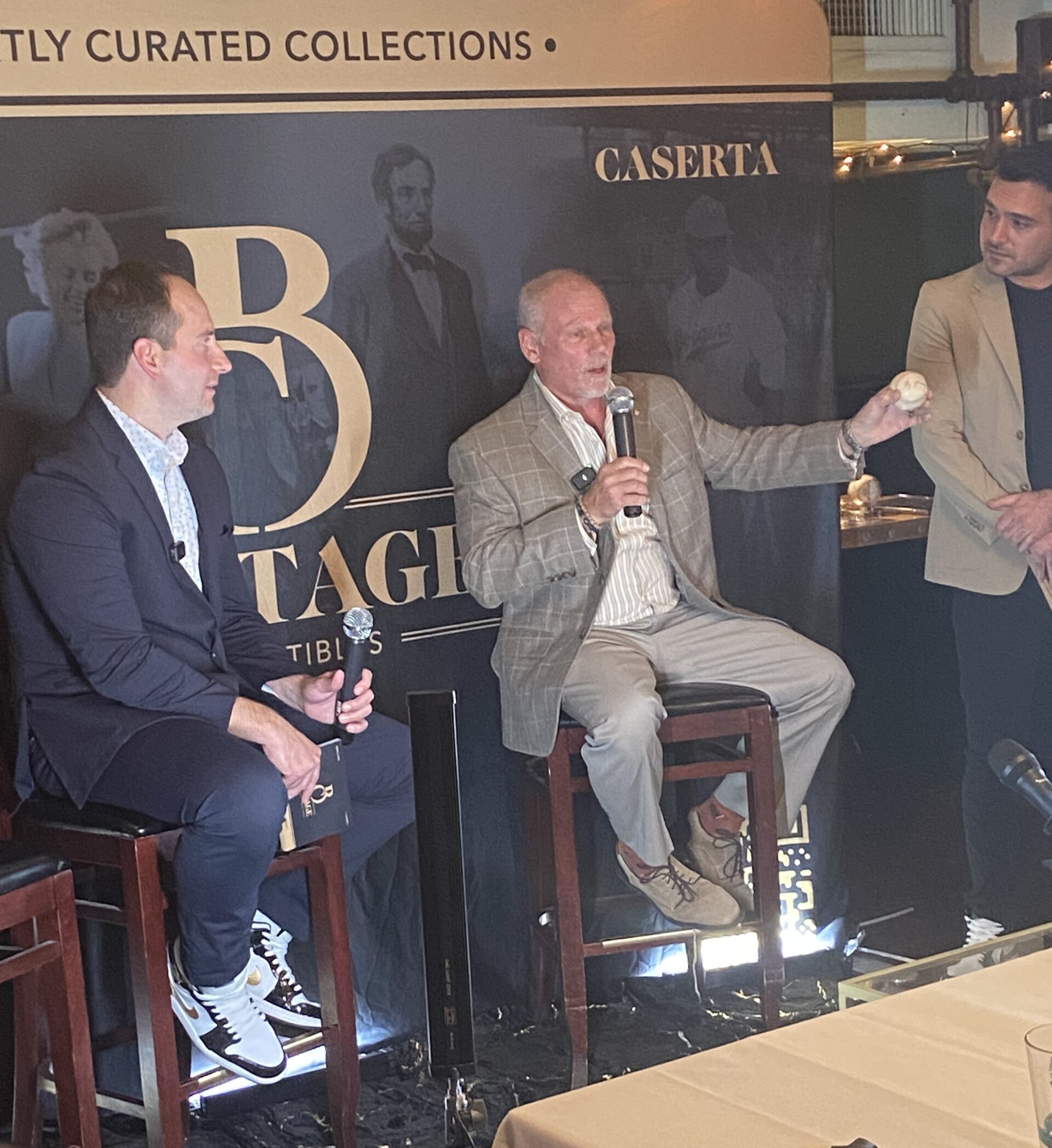
In April CCG bought James Spence Authentication to gain a foothold in the autograph business. The company already authenticated coins, comic books, currency, audio visual games, currency, and sports and non-sports cards. JSA’s founder is still on the job, though. “I am still authenticating,” Spence said. “I am not playing golf.” Spence said about 35% of the company’s authentication work is baseball related but the company does everything, including political, entertainment, music and world leaders.
Since Spence launched JSA 19 years ago, he says he has authenticated over one million autographs, including tens of thousands of baseballs. Spence still hand signs the company’s letters of authenticity for virtually everything that has significant value.
When it came time to play stump the authenticator, Spence was up the task. A Cy Young signed ball was quickly rejected. “The ink is way too fresh,” he said. “The ink hasn’t cured or sunk into the leather. The formation is bad. It doesn’t have the sharpness spontaneity. One dead giveaway had nothing to do with the signature itself, though. The printing on the official National League baseball dated to the decade after Young had died in 1955.
“This is an outright forgery,” Spence exclaimed. He noted that the three companies whose certification stickers had been applied to the ball had all been banned from eBay. To someone not familiar with the memorabilia market or autographs in general, it could have been a disastrous purchase.
“This is absolutely authentic,” Spence said after eying a 1968 Jackie Robinson signed check. “I had the pleasure of authenticating every single check when Rachel (Jackie’s widow) sold them to Lelands in the 1990s. She had folders for all of them.”
Even a check that has cleared doesn’t necessarily mean the signature is real. For example, checks from former MLB Players Association chief Marvin Miller many other corporate type checks are stamped. Many wives and family members of players have also been endorse them. Thurman Munson, Billy Martin, and Reggie Jackson fit this category; Spence explained.
A Babe Ruth signed ball with quote marks around “Babe” was a big whiff. To save time, Ruth stopped using quote marks around his first name when signing around in 1928 and this ball was from a later period. The autograph was also off center, another warning sign. “He hit a sweet spot on 97 percent of all balls.,” Spence said. And there had been other autographs on the ball. “There’s an abrasion on the north panel,” Spence observed. “Someone tried to turn this into a single-signed ball.”
The night’s cleanup hitter for show-and-tell was super collector, Kevin Cohen, who dropped every jaw in the room. His two best pieces, naturally, involved Ruth. An autographed Ruth on a creamy Harridge ball was authenticated by JSA and also graded a PSA 8. “You can see the autograph clear across the room,” he declared. Brigandi said it was easily a six-figure baseball.
Equally amazing was letterhead from a building where Ruth once lived. He signed it twice, and PSA encapsulated the autographs with a gem mint grade 10. “This shows you’re a true collector,” Brigandi joked. “An investor would have cut this in half and sold one to pay for the other.”
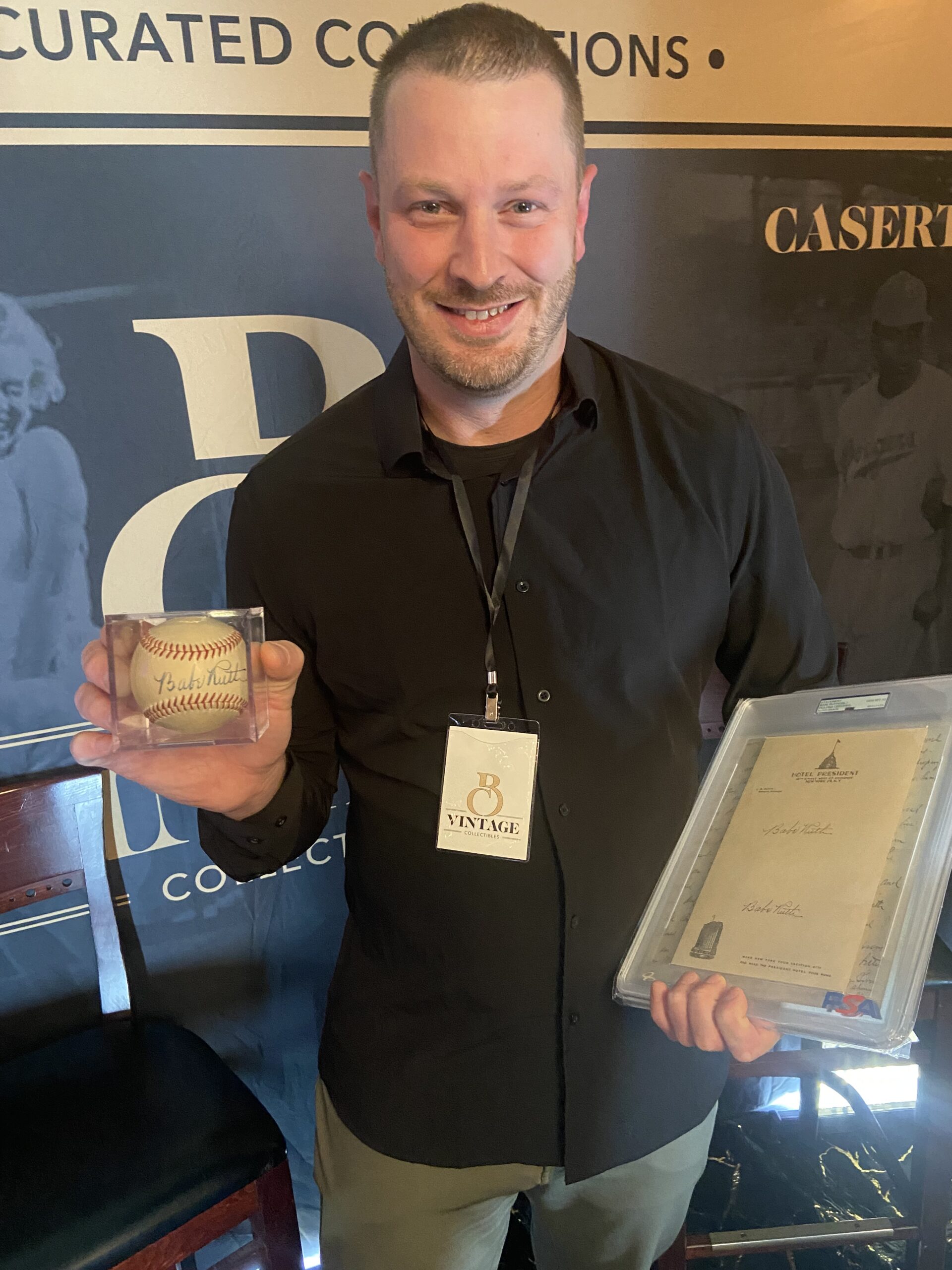
Cohen’s collecting philosophy is simple: “Eye appeal is the first thing. I have yet to lose on quality. I have batted .1000. And I never regret paying extra. I buy less. One, two or three items per year.”
The two least valuable show-and-tell items were the most poignant. Spence had brought along the 1968 Topps Mickey Mantle he pulled from a pack at a candy store back that year. After having Mantle sign it in 1990, Spence kept it in his wallet until it became thoroughly wrinkled. It was the first autographed card CCG authenticated when it bought Spence’s company.
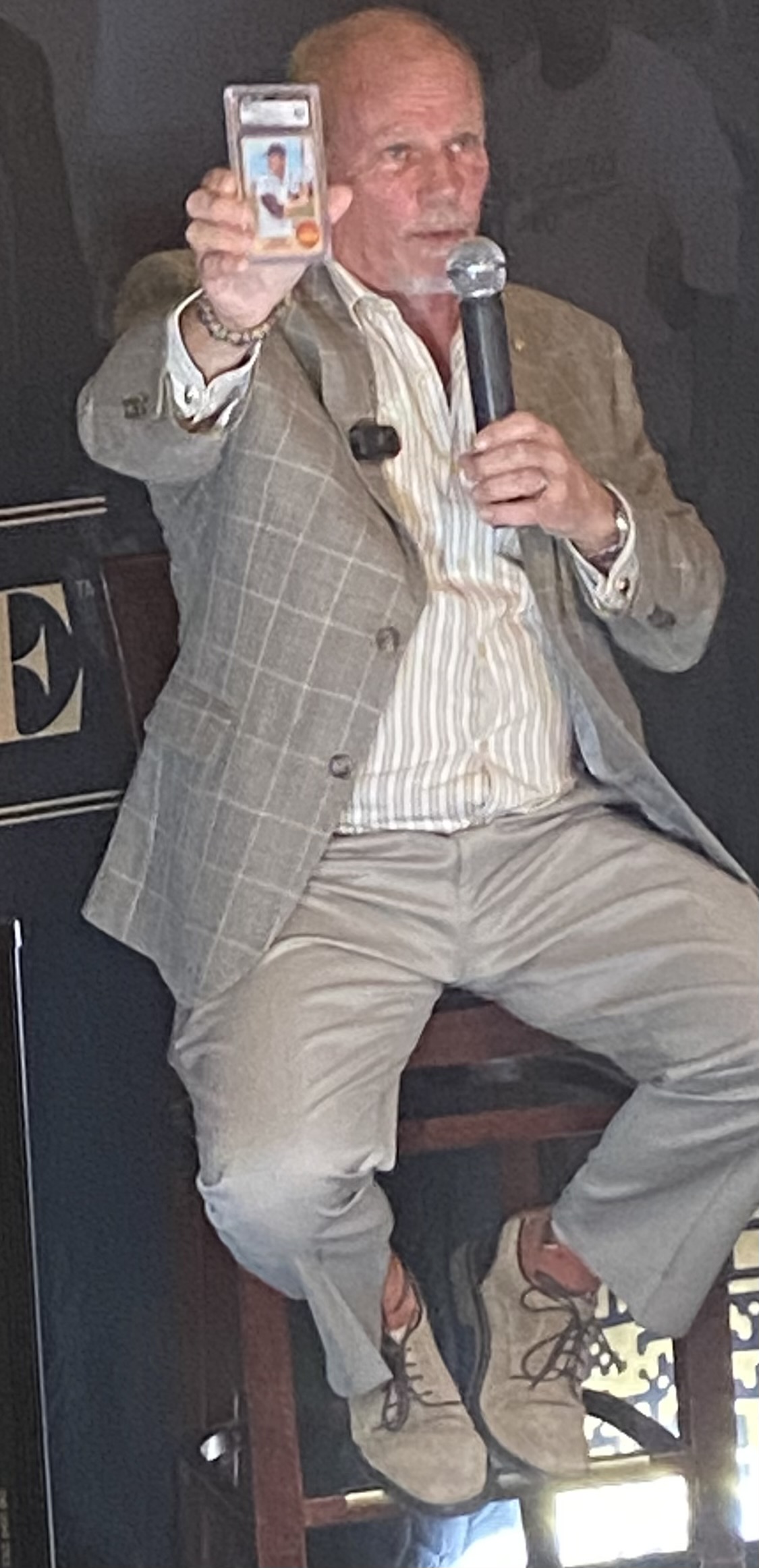
Spence then shared his Little League baseball from Englewood, NJ in 1970. when his dad was the coach. Looking at the names, he ruefully recalled a teammate who was stabbed to death in town at age 15. Another name was Warren Moore, a rap music pioneer.
The autograph guru’s parting gift was a pearl of wisdom. “If he is still alive, have your father sign a baseball,” he said.
My father, who passed away suddenly in 2005, and I were best friends. We attended countless baseball games together in several cities and I dragged him to card shows. One of my prized possessions is a foul ball he caught at Ebbets Field and dated “7/44.”
It never occurred to me to have him sign it. What a great idea that would have been.
