
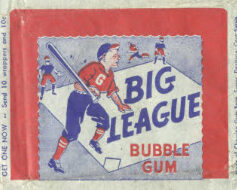
 The 1941 Goudey baseball card set brought to an end a near decade-long issuance of baseball cards for popular manufacturer Goudey. And while the set is often derided for a number of reasons including poor production and a lack of statistics/biographies, the cards are still heavily sought today for their rarity. Of Goudey’s standard baseball card releases, the 1941 cards are the most difficult to find.
One of the reasons some collectors avoid this set is because of its lack of stars. The only really big names found in the 33-card set are Hall of Famers Mel Ott and Carl Hubbell. And while their addition was a good start, the set could have included all sorts of other bigger names.
There’s a misconception that the set doesn’t include any other star players, though. And even beyond the other stars found, there are a few other cards worth collecting. Here are five under-the-radar cards found in the release. All cards can be found in four different colors — red, yellow, blue, and green.
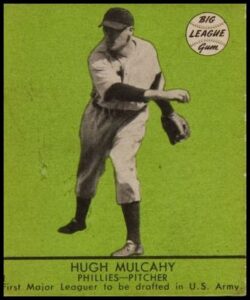 Hugh Mulcahy
Mulcahy’s card is one of my favorite in the set and it’s notable for a few reasons. It’s not only the first card in the set but Mulcahy was actually the first major leaguer drafted into the Army during World War II, which was already ongoing when this set was created. While other cards simply list the player’s name, team, position, and card number, Mulcahy’s includes a small caption indicating his status as the first drafted player.
Was Mulcahy a star? Not really. Despite being an All-Star in 1940, his 45-89 career record as a hurler with the Philadelphia Phillies and Pittsburgh Pirates does not exactly inspire. Nor does his career 4.49 ERA. Mulcahy even led the league in losses twice, as well as other undesirable categories, including hit batsmen, wild pitches, walks, and earned runs. Like many players, he ended up losing a large chunk of his career to the war, missing the 1941, 1942, 1943, and 1944 seasons. After playing his first six seasons with the Phillies, he returned to the club after the war before playing a final year in 1948 with the Pirates.
But the distinction of Mulcahy’s drafting lifts his card just above the common level and makes it one of the more notable cards in the set of interest. Lower grade copies can be found for under $100.

George Case
Many collectors today are unaware of Case’s career. But he is, without question, one of the underappreciated players of his generation.
Notably, Case was a major nuisance on the basepaths. A four-time All-Star, Case led the majors in stolen bases five consecutive years from 1939 through 1943. He won the stolen base title a sixth time a few years later and retired in the top ten in career stolen bases in the American League with 349. Inarguably, he was the top base stealer in the 1940s. Case was more than just a threat as a runner, though. He batted .300 in three different seasons and was a career .282 hitter playing for the Washington Senators and Cleveland Indians.
Still, it was his baserunning that gained him the most notoriety. According to this SABR article, Case was widely recognized as the fastest player in baseball and reportedly lost to Jesse Owens in a 100-yard-dash by only a tenth of a second. There’s even photographic proof, showing just how close the race actually was.
Despite his legendary career as a baserunner, most of Case’s cards, including this one, sell for common prices.
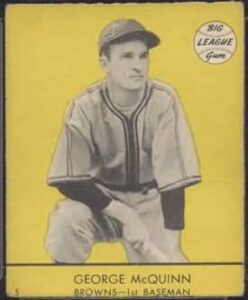 George McQuinn
McQuinn is a virtual unknown but was another standout player from the 1940s.
He played a total of 12 seasons, making an eyebrow-raising seven All-Star teams. McQuinn’s career was aided by the fact that he did not lose time to World War II as many other players did. McQuinn was initially considered by the Army, but failed a physical because of back issues. Those back issues didn’t help his career but he still overcame them to be an effective player.
McQuinn batted .276 for his career, but was exceptional at times. In his first full season in the majors, he hit .324, following that up with a .316 sophomore campaign. He nearly hit .300 two years later in 1941 when this set was produced (.297) before hitting .304 in 1947 at the age of 37. That year was, perhaps, McQuinn’s best season. He finished sixth in Most Valuable Player voting, behind only Joe DiMaggio, Ted Williams, Lou Boudreau, George Kell, and Joe Page.
McQuinn’s 1941 Goudey cards also sell for very modest prices.
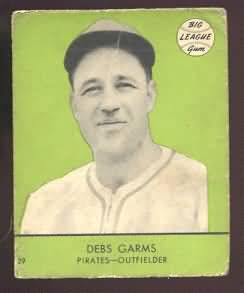 Debs Garms
Garms never made an All-Star team, but he is still one of the best hitters found in the set.
A bit of a journeyman, Garms played a total of 12 seasons with the St. Louis Browns, Boston Bees, Pittsburgh Pirates, and St. Louis Cardinals. He was a career .293 hitter, surpassing the .300 mark in four seasons. His career was highlighted by his 1940 season when he won a batting title with the Pirates, batting an incredible .355. Garms was still going strong when he retired. As a 38-year-old in his final season, he hit .336 with the Cardinals. Surprisingly, Garms never made an All-Star team.
Part of that was likely because Garms was not always an everyday player. He played only part-time in several seasons, in part, due to some defensive deficiencies, as stated here by SABR.
Despite being a batting champion and a near lifetime .300 hitter, Garms’ 1941 Goudey cards are also treated as commons.
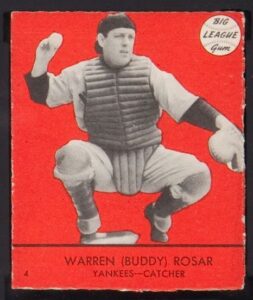 Buddy Rosar
Six-time All-Star catcher Frank Hayes was another candidate for this list. But I chose fellow catcher Buddy Rosar for the final spot here. The two, however, are undeniably linked.
With Rosar’s five All-Star appearances, he and Hayes combined for a total of 11 trips to the All-Star Game. Both played in the American League and alternated trips to the game with at least one of the appearing in each year from 1939 through 1948.
Rosar made the All-Star team with three different teams — the New York Yankees, Cleveland Indians, and Philadelphia Athletics. And while his impact was minimal (only appearing in one game), he won World Series titles with the Yankees in 1939 and 1941. A serviceable hitter with a .261 career batting average, where Rosar really starred was defensively. He led the league’s catchers in fielding percentage in four different seasons.
Rosar is yet another bargain in the set with mid-grade copies at around $100, despite his many All-Star appearances.
