
It’s distinctive. There’s no doubt about that. Catch a glimpse of it and sports fans know exactly who’s playing.
The blue turf at Boise State’s Albertsons Stadium is one of the most famous pieces of land in all of college football.
With the “Smurf Turf” being replaced this summer after 40 years and stadium memorabilia proven to be popular with collectors and fans, the school was open to the idea of selling off pieces of it.
Enter CollectU, a college collectibles company whose pitch to clients is “transforming stadium renovations into revenue.” At CollectBSU.com, fans could make their dreams come true — for a price, of course.
CollectU and Boise State sold off pieces of the blue turf in early May, ranging in size from small swatches (6 inches by 4 inches that include a QR code that links to a video history of the turf) for $40 apiece, to a 400-square-foot (20 feet by 20 feet) “fan cave” — a piece of authentic blue turf that sold for $25,000.
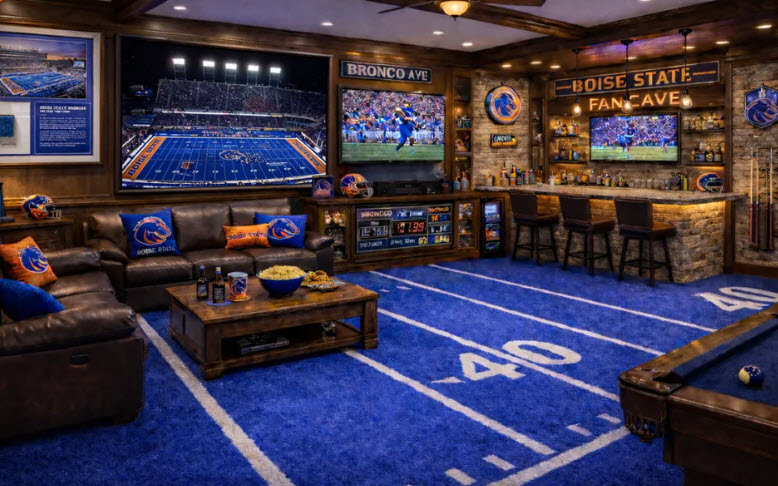
It is a win-win for the company and the school. The money generated goes back into Boise State’s athletic department account.
According to CollectU founder Jay Sharman, a man from Idaho forked over $25,000 for the marquee item on the auction list.
“He’s turning a pole barn into a fan cave. … it’s a massive project,” Sharman said. “He’s not going to be done with it until the fall,” which coincides with the stadium turf renovation, set for late June.
“I’ve learned more about taking up and replacing blue turf than I ever thought I would know,” he said. “It’s not a simple procedure. And so, it takes about three weeks.”
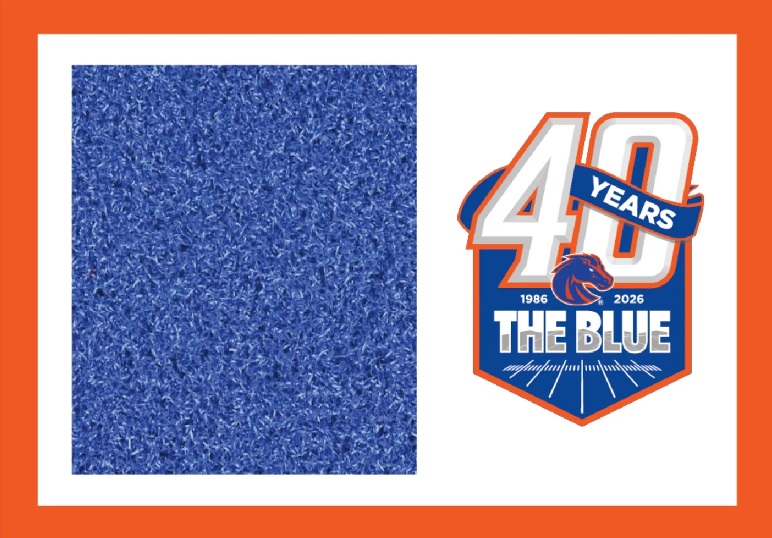
Other items in the auction included a 40-yard line turf marker measuring 6 feet by 12 feet to honor the 40th anniversary of the turf, which sold for $4,000; a 6-foot-by-4-foot “2 blue turf collectible” of the 20-yard line — the “2” being a nod toward 2024 Heisman Trophy runner-up Ashton Jeanty — sold for $2,000.
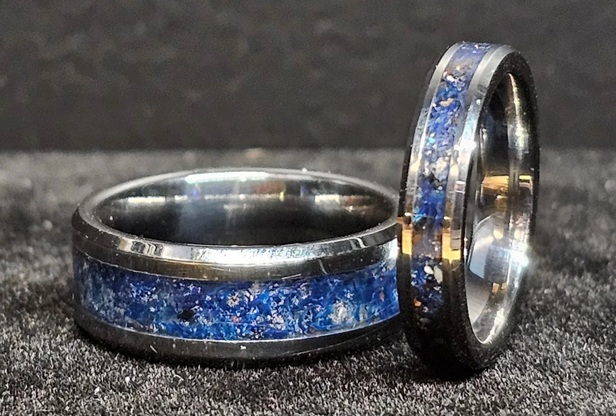
Among the more unusual uses? A $300 hand-crafted tungsten ring injected with fragments of the blue turf.
Sharman, who founded CollectU in January 2025 and has seven clients including Boise State — the other five schools on board include Tennessee, Penn State, Northwestern, Northeastern and Connecticut; along with Ravinia Festival, the Chicago-area music venue — said he was pleased with the response for the blue turf items. The swatches are a hot item, he said.
“We sold 250 today, one every 90 seconds,” Sharman said. “We’re closing in on 500 units of the swatches already.
“I was very pleased with the response. It’s not our first rodeo and you never know because each fan base is different. (The) time of year is different. A lot of these things are theory until you put it out there and see what happens. So I was thrilled, to be honest.”
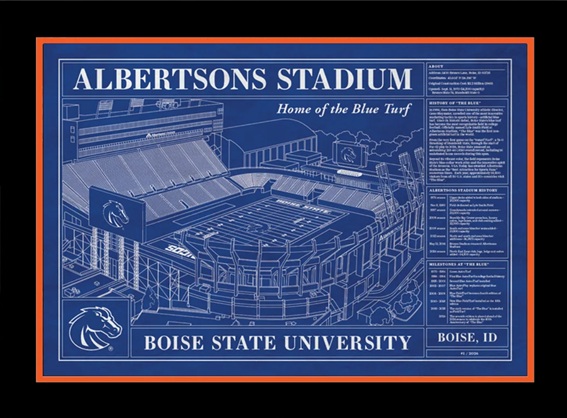
Another one of the collectibles pays homage to former Boise State athletic director Gene Bleymaier, who came up with the idea of blue turf in 1986. For $325, fans can purchase a 12-inch-by-12-inch, free-standing shadow box that includes a 2-inch-by-2-inch swatch of turf and a photo of Albertsons Stadium. The collectible, which features Bleymaier’s autograph, is limited to 500 pieces.
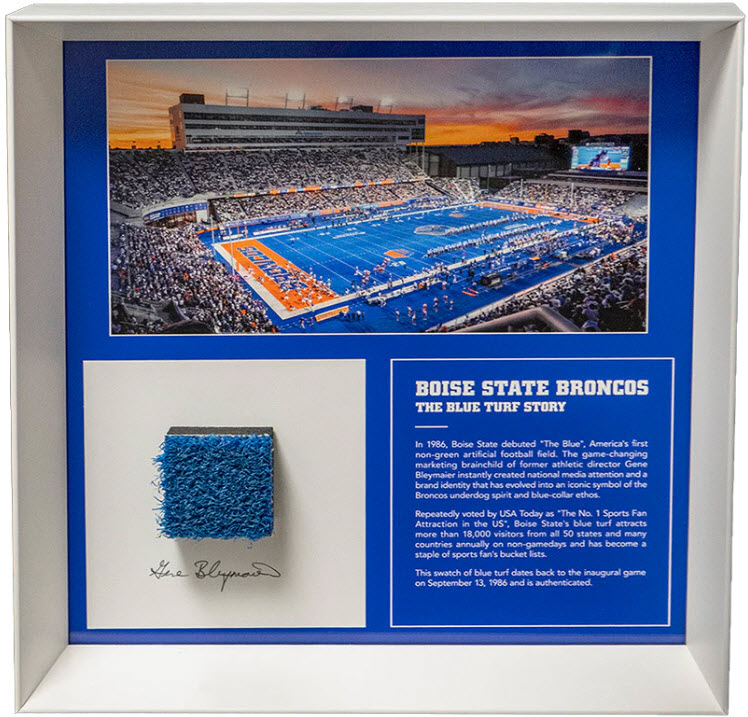
“It’s actually one of my favorite pieces in the history of our company,” Sharman said. “I can’t think of a more iconic sports marketing thing than the blue turf at Boise.”
Current BSU athletic director Jeramiah Dickey said the changing world of college athletics calls for some creative thinking to raise money.
“It’s my job to continue to invest in our program, and to do that, I need resources,” Dickey told The Athletic. “You’re going from a place of stretching dollars to how do you make more and how do you set up your infrastructure in your department to do so to take advantage of opportunities.
“This is low-hanging fruit. We know that every seven to nine years, we’re going to have to change out the blue (turf). We know the blue has power.”

Sharman, a 1995 graduate of Northwestern University, said he approached officials at Boise State once he learned about the turf renovation, meeting with Dickey and head football coach Spencer Danielson.
“We approached them, we cold-called them and they couldn’t have been nicer,” Sharman said.
But as a history minor who loves storytelling, Sharman said he heard a gem of a tale when he interviewed Bleymaier.
“He was the mastermind behind this,” Sharman said about the 72-year-old who served as BSU athletic director from 1982 to 2011. He noted that Bleymaier and university president John H. Keiser kept the idea quiet.
“The only people that knew when they unrolled that blue turf before the first game in September 1986 was the president and Gene, because he knew that if he told people, he’d get shot down,” Sharman said. “And when he rolled that thing out — there was no internet, obviously, so there was no color proofing — he was like, ‘What were you thinking?’
“He goes, ‘God, I hope they got the right shade of blue.’ He literally didn’t know until they unrolled it.”
Then Sharman tells his own story. Call it karma, but he found parts of the original turf while touring deep inside Albertsons Stadium when he met with BSU athletic officials.
“The first time we went to Boise State, I went with our CollectU team,” he said. “We walked around for three hours with their head of facilities and their head of equipment.”
At the very end of the stadium tour, the group entered a room in the concourse and found some seat backs from the basketball arena. There were cardboard boxes but Sharman noticed something beneath them.
“There was this shaggy, thin blue rug,” he said. “And I just kick it. I’m like, ‘What’s this?’ And they’re like, ‘Oh, that’s the last remaining piece of the ’86 blue turf.’
“And I was like, ‘Are you kidding me?’ This was like the Rosetta Stone,” Sharman said. “This is the most valuable piece of playing surface in the world. And you’re using it as a cardboard box protector from leakage?”
Sharman did not hesitate.
“So we rolled it up. We took it. And that’s the only remaining piece,” he said. “And we have it. And we’ve chopped it up into the shadow boxes. But I mean, literally, you wonder, if I hadn’t asked that question. … Those are my favorite moments, when you find these kind of ‘aha’ things.”
The “Smurf Turf” is a form of pride at the school and among Boise residents.
In 2011, the university obtained a federal trademark registration for “the color blue as applied to artificial turf,” the school notes on its website.
“It’s just amazing how it’s not just the school. The entire city and state identify with that football field,” Sharman said. “It’s a smart move too.”
Before CollectU was incorporated, Sharman struck paydirt by connecting with his alma mater in 2024.
He knew that Northwestern was about to demolish the original site of Ryan Field, which was built in 1997 and was named for 1959 alumnus Patrick G. Ryan.
Sharman, who knew the Ryan family from his connections in the Big Ten, visited the stadium in Evanston, Illinois, three days before its demolition and spoke to some officials.
“I was friends with the Ryans, and I went there on their behalf just to get a couple of seats and signs,” he said. “I walked in there and it looked like game day. Every seat was intact. Every sign was intact.
“I turned to the head construction guy and I said, ‘Are you taking anything?’ and he said, ‘Taking what?’”
Sharman asked if he could help himself.
“He said, ‘You’ve got 72 hours. And you can take what you want,’” Sharman said.
Sharman rented a truck from Home Depot and called a mover he knew and asked him to bring his box truck.
“And 72 hours later, we had a couple of box trucks filled, and we sold out.”
Sharman wound up partnering with Northwestern and collected $300,000 in sales.
“I thought, ‘If we can do this at Northwestern, where our fan base relative to others is not exactly up to snuff …’ — so, that was the birth of the company.”
Elizabeth Conlisk, CollectU’s project manager, said that the company partnered with UConn around the Final Four and there will be another round of product drops at collectuconn.com.
“We just opened in South Windsor, Connecticut, about 30 minutes from Storrs, the UConn campus concept pop-up store called the Gampel Collection,” she said.
Conlisk added that the next drop for Boise State items are a few weeks away.
Sharman said he is hoping to expand CollectU’s reach to other colleges and perhaps even to professional teams.
“We’re having that conversation right now. The good news in this business is that there’s more business than even if our staff — we have a staff of 10 right now — if our staff was 100, we still couldn’t go after all the projects that are out there.
“It’s an arms race. But it’s a good business to be in. We’re super excited about the future.”